A Software Discovery Checklist for Growing Businesses in Kansas City, Kansas
Spybroski Team
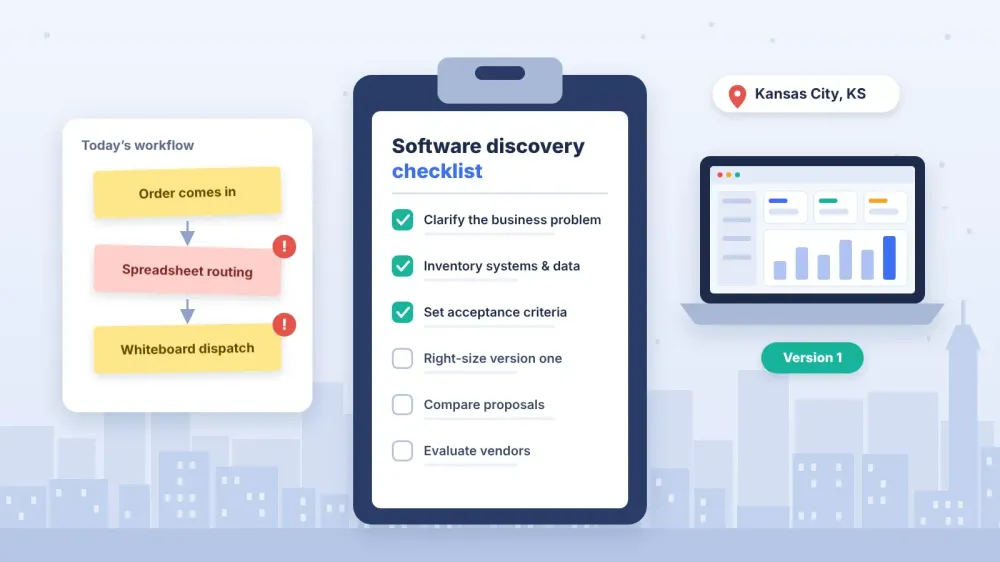
Many Kansas City businesses jump into custom software projects with enthusiasm but without alignment. Teams skip past workflow mapping, data inventories, and budget guardrails, then wonder why the project runs over budget or delivers something nobody asked for. The result is rework, stalled timelines, and lost trust between business leaders and developers.
Step 1: Clarify the Business Problem
Before contacting any development team, founders and managers need honest answers to a few foundational questions. Custom software can improve operational efficiency and reduce manual processes, but only if the problem is clearly understood first.
Consider concrete, local examples. Maybe your Wyandotte County warehouse team still uses spreadsheets for routing and truck assignment. Perhaps your downtown Kansas City service dispatch board lives on a whiteboard. These are real problems that deserve real workflows, not vague requests for "a better system."
Business workflow mapping should be aligned with software capabilities during the selection process. Including operational stakeholders in the software discovery process can prevent alignment gaps between what management wants and what frontline staff actually need.
Produce a one page problem summary. Email it to internal stakeholders and potential vendors as shared context. This single document will save you hours of repeated explanation later.
Step 2: Inventory Your Existing Systems and Data Sources
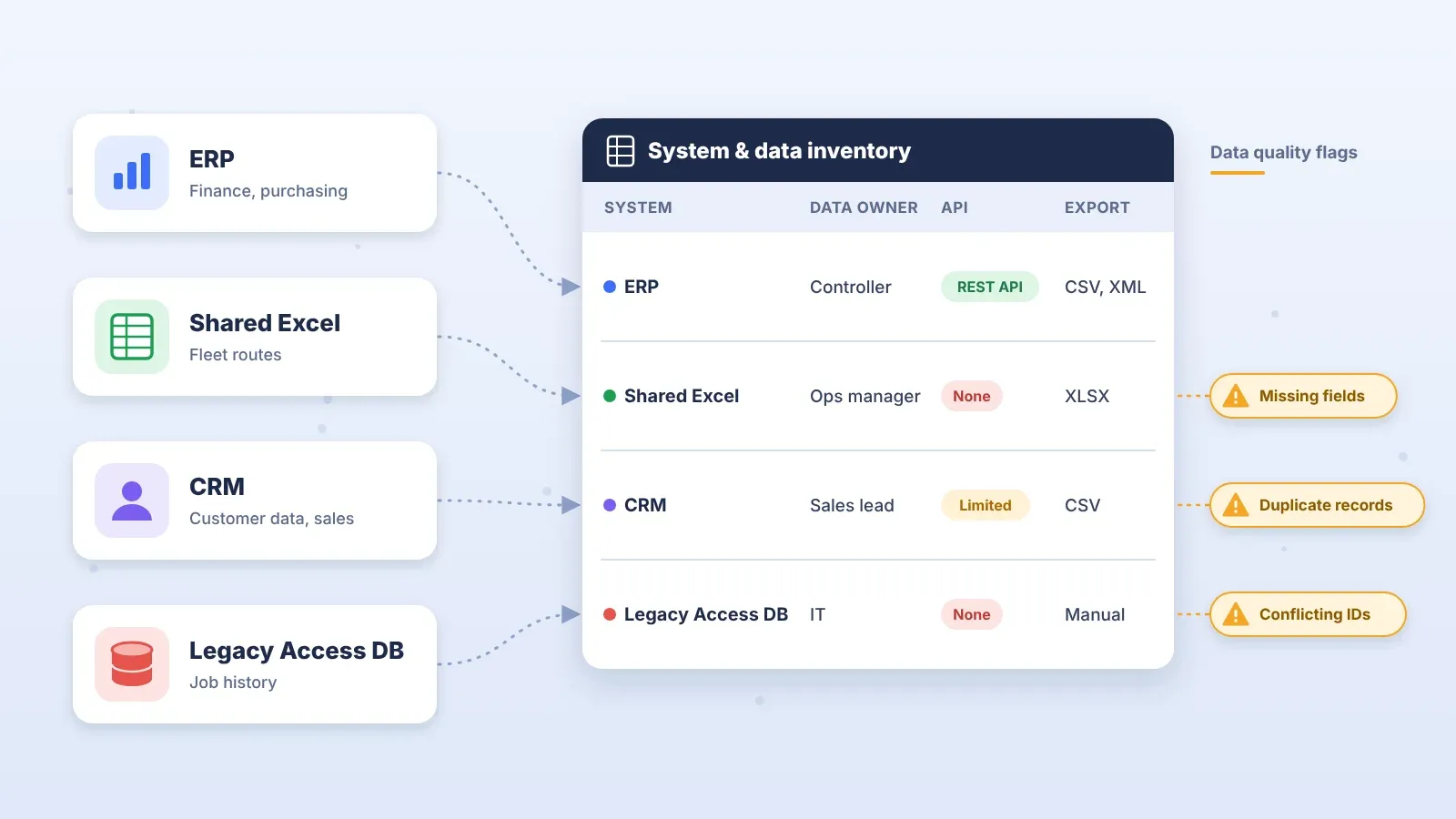
Many Kansas City businesses underestimate how many tools already power their daily operations. A logistics company in the metro area might run an ERP for finance, a separate WMS for inventory, a shared Excel file for fleet scheduling, and a handful of cloud apps nobody in IT approved.
Make a simple table listing each system:
| System | Data Stored | Data Owner | Integration / API | Export Format |
|---|---|---|---|---|
| ERP | Finance, purchasing | Controller | REST API | CSV, XML |
| Shared Excel | Fleet routes | Ops manager | None | XLSX |
| CRM | Customer data, sales | Sales lead | Limited API | CSV |
| Legacy Access DB | Job history | IT | None | Manual export |
Capture data quality issues: duplicate records, missing fields, outdated entries, and conflicting IDs across systems. Integration capabilities should be assessed during software evaluations to avoid data silos. Software should integrate seamlessly with existing business applications, and it should allow for easy data migration if changing vendors becomes necessary.
Step 3: Set Measurable Acceptance Criteria for Version One
Kansas City companies should avoid vague goals like "make it easier" and instead define measurable outcomes for the first release. Businesses should define measurable success criteria before evaluating vendors.
Criteria should cover speed, accuracy, user adoption targets, and nonfunctional items like response time and uptime. Measurable growth metrics should be established to assess software effectiveness over time. Custom application requirements includes phases like design, testing, and deployment, and your acceptance criteria will serve as the thread connecting all of them.
Step 4: Right Size the Scope for Your First Release
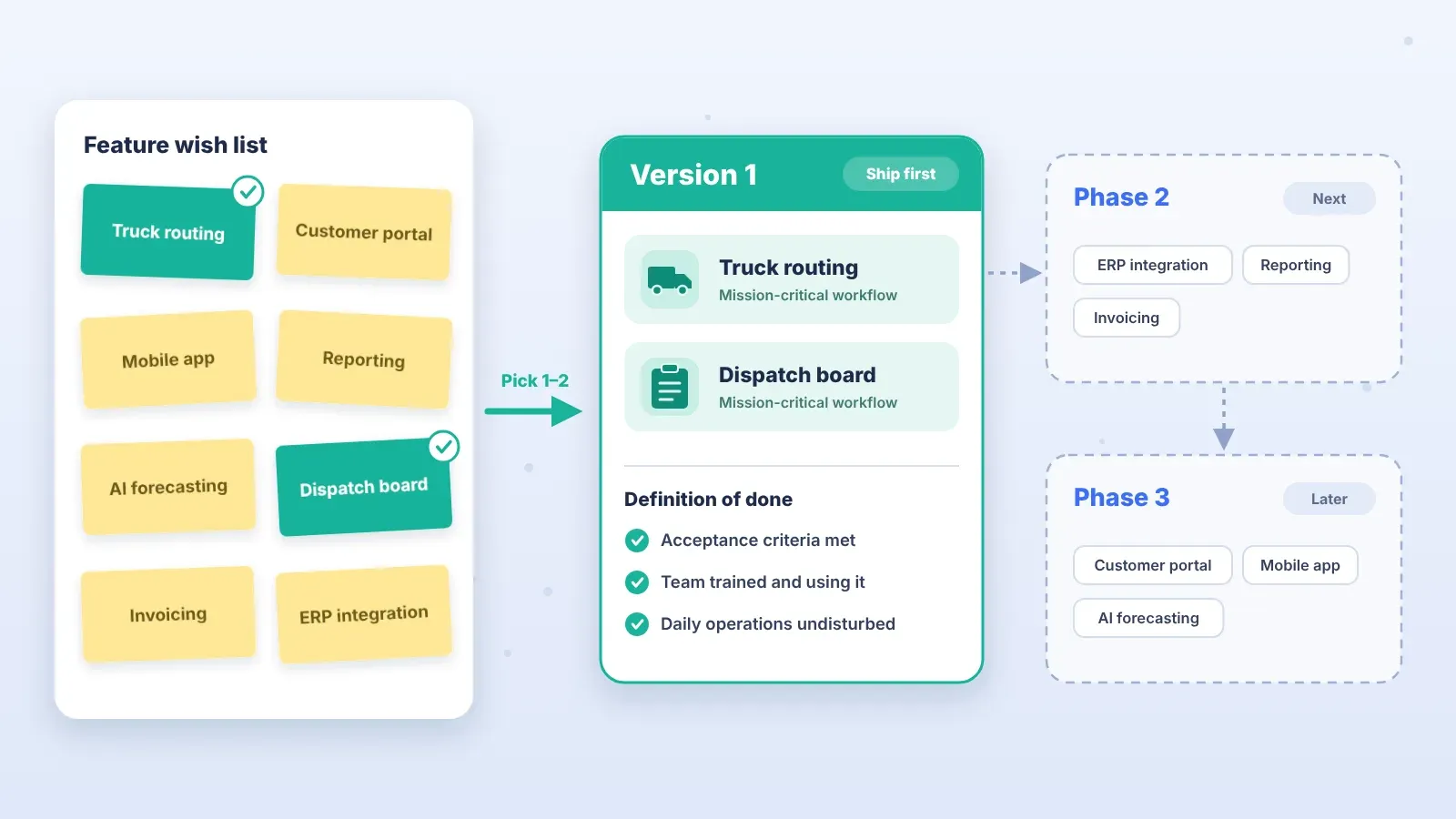
A software discovery checklist exists to keep the first release focused and shippable. The temptation to build everything at once is strong, but a phased software implementation can help manage change and risk. Phased modernization minimizes disruption to daily operations, and software solutions must be able to adapt to changing business needs as companies grow.
Choose one or two mission critical workflows for version one. Agree internally on what "done" means so nobody moves the goalposts mid project. Custom software development in Kansas City, KS ensures that development begins with evidence gathered during discovery, not assumptions made in a sales pitch. "Scope discipline is what separates a project that ships from one that stalls. When Kansas City businesses define their first release tightly, our delivery team can produce accurate estimates and realistic timelines."
Step 5: Compare Proposals from Developers Using Consistent Input Data
Once workflows, data sources, roles, and acceptance criteria are documented, Kansas City companies can send the same discovery packet to multiple software developers. This is where the checklist pays for itself.
Consistent input allows apples to apples comparison across timelines, team composition, tech stack, cost structure, and assumptions. Vendor evaluation should include customer references and reputation assessments. The total cost of ownership includes implementation, training, and ongoing support, not just the initial build price. Establishing a realistic budget is crucial for effective software investment planning.
Evaluating vendor reliability and support is crucial for long term partnerships. Vendor contract renewal and data export terms should be clearly understood before agreements are signed. Decision makers should cross check vendor claims with independent resources, such as analysis from MIT Technology Review, when assessing feasibility of emerging technologies proposed in a vendor's pitch.
Step 6: Evaluate Each Vendor's Technical Approach and Communication Style
Technical due diligence protects long term maintainability, especially for systems running freight, finance, healthcare, or field services across the Kansas City metro. Companies should explore local resources for assistance in the software discovery process.
Legacy systems can slow cloud adoption and limit AI initiatives. Legacy modernization reduces technical debt and improves efficiency. Modernization strategies help organizations adopt cloud-native architectures, and AI features improve decision-making in software solutions. Generative AI can enhance productivity and decision-making speed when layered onto a properly architected platform.
Ask vendors to walk through a past case study with a similar problem. How did they build, test, launch, and support the solution? Did they avoid disrupting daily operations? Stress communication expectations: regular status updates, a single accountable delivery lead, clear escalation paths, and work hours that fit Central Time.
Researching independent reporting from outlets like Ars Technica can help you understand tradeoffs between different frameworks, clouds, and AI tools that vendors may propose.
How SoftDoes Helps Kansas City, KS Businesses Turn Discovery into Delivery
SoftDoes works as a software engineering partner for enterprises and scale ups across the Kansas City metro. The focus is on digital transformation that protects what already works while building what comes next. The team includes senior engineers with hands-on experience across web applications, mobile applications, cloud platforms, and AI solutions.
SoftDoes uses this discovery checklist in practice: mapping real workflows, auditing systems, defining version one scope, and creating a phased roadmap for custom software and innovative solutions. The company's digital strategy emphasizes transparent pricing, clear assumptions, and a local team that treats discovery artifacts as living documents.
Custom software development can modernize legacy systems gradually without disruption. Whether you need to replace legacy software powering a dispatch tool without disrupting field technicians, consolidate disparate finance tools into a secure architecture, or build enterprise platforms that handle tens of thousands of transactions, the process starts with discovery done right.
Bring your documented checklist to a discovery session with SoftDoes. Top software companies earn trust by showing you how they think before development begins. When the business case is clear, the honest answer about timeline, cost, and operational risk becomes possible.