Best UGC Platforms in 2026: Where Brands Find Creators (and Creators Find Paid Work)
Spybroski Team
A year ago, "UGC creator" sounded like a side hustle a few people on TikTok talked about. Now it's a real job title, and brands are spending real ad budgets on it. That's why so many people are hunting for the right UGC platforms. Some are brands that need 20 product videos by Friday. Others are creators looking for their first paid gig.
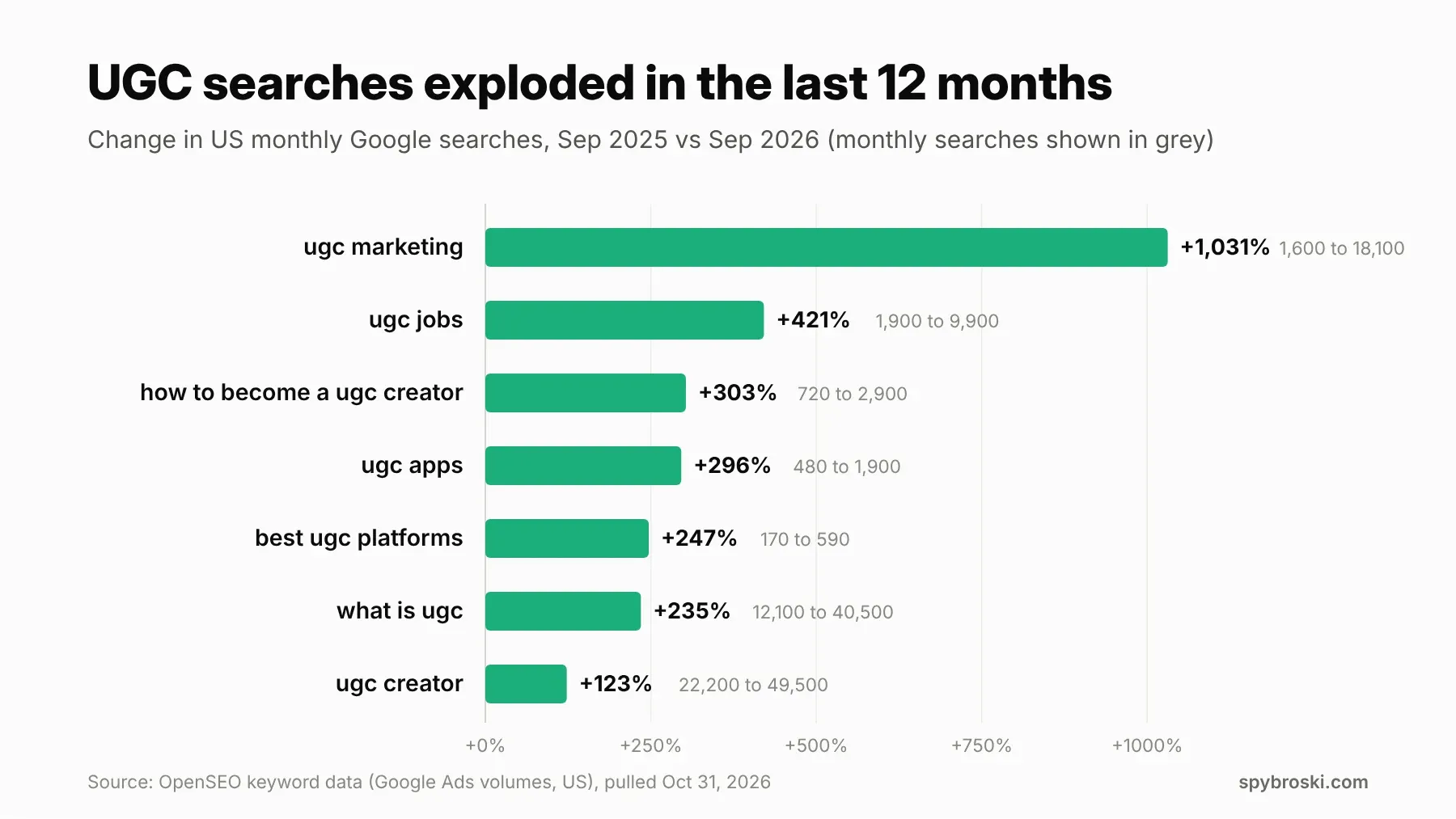
The search data backs it up. US searches for "ugc jobs" jumped from about 1,900 a month in September 2025 to 9,900 in September 2026. "How to become a ugc creator" went from 720 to 2,900. And "ugc marketing" grew more than tenfold, according to keyword data we pulled from OpenSEO.
So which platform should you use? It depends on which side of the deal you're on. It also depends on your budget and how much work you want to hand off. This guide compares eight UGC platforms on pricing, creator pools, and usage rights, then covers how to pick one, whether you're hiring or getting hired.
What is UGC, and what do UGC platforms actually do?
UGC stands for user generated content. Originally it meant anything real customers posted about a brand, like a review video or an unboxing on Instagram. In marketing today, it usually means something a bit different. A brand pays a creator to make a video that looks and feels like a real customer made it. Then the brand runs that video as an ad or posts it on its own channels.
Here's the part that surprises people. A UGC creator doesn't need a big following. Brands aren't paying for reach. They're paying for content that doesn't look like an ad. That's why so many people with 300 followers are getting paid gigs.
UGC platforms sit in the middle. They help brands find creators, send briefs and products, approve videos, pay creators, and lock down usage rights. Most fall into one of three groups:
- Marketplaces. You post a brief, creators apply, and you pick who to hire. Cheaper, but you do the managing.
- Managed services. The platform picks creators, handles the back and forth, and delivers finished content. Pricier, but hands off.
- Hybrids. A marketplace with an optional team that runs things for you.
One quick clarification before the list. Tools like Yotpo or Bazaarvoice collect reviews and posts from your existing customers. Those are UGC platforms too, but a different kind. This guide focuses on platforms that connect brands with creators.
The best UGC platforms in 2026
Each platform below gets the same treatment: what it is, who it suits, what it costs, and how it works for creators. Prices and numbers come from each company's own website as of October 31, 2026, so check them before you buy.
JoinBrands
JoinBrands is a creator marketplace for UGC, influencer content, and TikTok Shop affiliate campaigns. It says it has more than 4 million creators, and brands can filter by niche, location, age, and more.
Pricing is easy to read. The free plan has no monthly fee but adds a 15% platform fee to each creator payment. Paid plans run $99, $299, and $499 a month, with the fee dropping to 12%, 10%, and 8%. Content starts at $10 for UGC images and $25 for videos, and payments sit in escrow until you approve the work. Brands get full licensing and distribution rights.
Best for: smaller budgets, TikTok Shop sellers, and brands that want to test UGC without a big commitment.
For creators: you sign up as a creator and apply to campaigns. JoinBrands also runs a Creator Academy for people starting out.
Influee
Influee is a UGC marketplace with more than 180,000 creators across 30+ countries, including the US, UK, Canada, and Australia. The headline price is UGC videos starting at $83, and creator profiles show their own per video rates.
The process is quick. Creators apply within about 24 hours, and videos land around 7 to 10 days after they get your product. Influee includes unlimited revisions and usage rights, plus a built in editor with subtitles in 65 languages and support for Partnership and Spark Ads.
Best for: brands that want simple video orders without a big platform contract.
For creators: you set your own per video price on your profile, and Influee handles contracts and payments.
Backstage
Backstage is best known as a casting site for actors, and it now has a UGC marketplace built in. Brands browse creators who publish their rates, order content, and pay up front. If a creator doesn't respond within 72 hours, the order cancels and the money goes back.
One detail to read closely is the license. According to Backstage's help center, brands get an exclusive commercial license with paid ad use for 6 months and organic use for 12 months. That's shorter than the perpetual rights some other platforms include, so plan your ad schedule around it.
Best for: brands that want polished, on camera talent and are fine with time limited rights.
For creators: you publish your rates on your profile and respond to requests within the 72 hour window.
Billo
Billo focuses on UGC for performance ads. It has a network of 5,000+ vetted creators, tools for scripts, creator matching, and ad variations, plus a managed service if you'd rather hand it off. Billo shares its own ad data too. It says Billo ads averaged an $82 cost per acquisition versus $92 for other ads, based on 1.41 million Meta ads. That's the company's own number, so treat it as a claim, not a guarantee.
Pricing isn't listed publicly. You see it after you sign up, which is free.
Best for: ecommerce brands that test lots of ad creatives every month.
For creators: Billo has a "Become a creator" signup, though its homepage doesn't spell out pay rates.
Insense
Insense pairs a creator marketplace with tools for running creator content as ads. It lists 115,000+ creators in 57+ countries and says brands get applications within 48 hours and content within 14 days. Its standout feature is ad support: brands can request Meta Partnership Ads access or TikTok Spark Ad codes right through the platform.
It's one of the pricier self serve options. The Brand plan costs $400 a month billed yearly or $500 billed quarterly, plus a 10% marketplace fee, and creator payments are extra. There's also a one month trial plan at $650 and an agency tier.
Best for: brands and agencies that run a lot of creator content as paid social ads.
For creators: you join through the Insense app on iOS or Android, and payments run through the platform.
Trend
Trend connects brands with photographers, videographers, and creators for product photos and videos. It lists 3,700+ creators in its network and says it has delivered more than 31,500 videos and 46,000 images. There's no subscription. You pay per project, and brands get 100% licensing and distribution rights.
Trend also covers lost or stolen products, which matters if you're shipping expensive items to creators.
Best for: brands that need a steady mix of product photos and short videos.
For creators: Trend reviews applications from creators of all backgrounds, and pay is set per project.
Minisocial
Minisocial is a fully managed service for micro influencer and UGC campaigns. You fill out a brief in about 10 minutes, Minisocial picks creators for you to approve, and its team handles outreach, follow ups, and delivery. Most campaigns take 4 to 6 weeks.
Pricing starts at $3,000 for a campaign with 10 creators, creator fees included, with no long term commitment. Brands get fully licensed videos plus Meta and TikTok ad codes.
Best for: teams that want UGC without spending their week managing creators.
For creators: Minisocial invites creators who fit a project, and you can also apply to its database.
Cohley
Cohley is built for mid market and enterprise brands that sell physical products in the US and Canada. Brands post a creative brief, creators apply, and an AI agent called Finn helps vet applicants and check submissions against the brief. Every asset comes with full, perpetual usage rights.
Pricing is by quote after a demo.
Best for: larger product brands that need a high volume of content with tight brand rules.
For creators: you sign up through Cohley's creator portal and complete FTC disclosure training before you apply to briefs.
UGC platforms compared
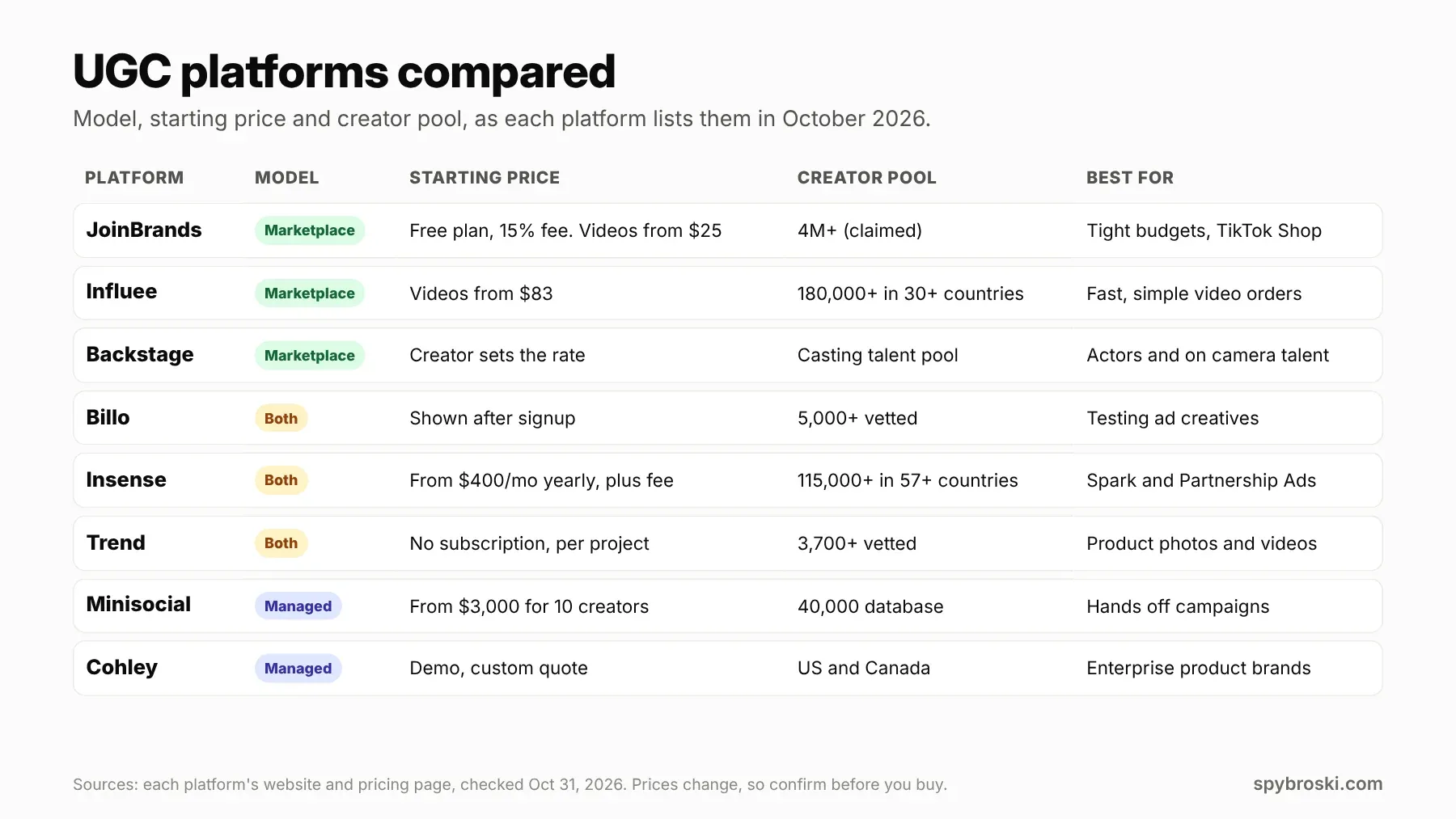
Here's the whole list side by side.
How to choose a UGC platform for your brand
Feature lists all start to blur after a while. These five questions narrow it down fast.
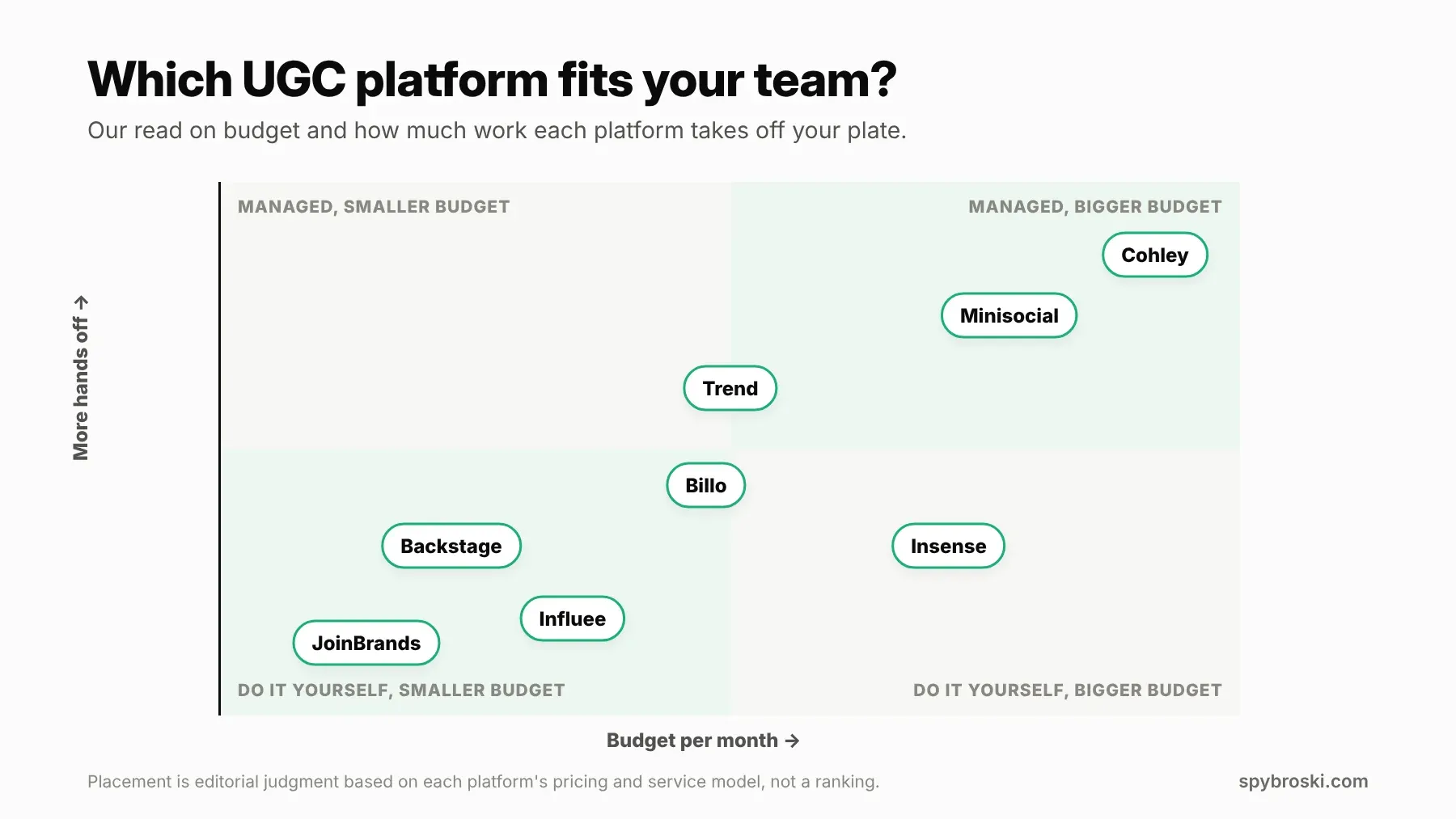
- How much do you want to manage? If you have someone who can write briefs, review videos, and chase creators, a marketplace saves money. If you don't, pay for a managed service and buy your time back.
- What's your real budget per video? Count the platform fee, the creator fee, and the product you ship. A $25 video on a 15% fee plus a $40 product isn't a $25 video.
- How long do you need the rights? Perpetual rights and 6 month ad rights are very different deals. Match the license to how long you plan to run the ads.
- Will you run the videos as ads from the creator's account? Then look for Spark Ads and Partnership Ads support, like Insense and Influee offer.
- Where are your customers? Creator pools differ by country. Cohley focuses on the US and Canada, while Influee and Insense cover dozens of countries.
One more tip. Before you hire anyone, look at the creator's public profile and recent videos. Our free TikTok profile viewer lets you check a creator's public TikTok without logging in, and the Instagram profile viewer does the same for Instagram. Ten minutes of homework beats a week of revisions.
For creators: the best UGC platforms for beginners
Now the other side of the table. If you're trying to land your first UGC job, here's the honest picture.
Searches for "ugc platforms for beginners" went from about 30 a month to 320 in a year. A lot of people are trying to break in at once. The creators who stand out look ready on day one.
Start with marketplaces where you can apply to open briefs. JoinBrands, Influee, Backstage, and Insense all let creators join and pitch for work. Managed services like Minisocial and Cohley tend to invite creators, so get on their databases too, but don't count on them for your first gig.
Where to find UGC jobs
Searches for "ugc jobs" grew more than fivefold this year, so you're not imagining the competition. The best place to look is the job board inside each marketplace, like JoinBrands, Influee, Insense, and Backstage. Check them often, because good briefs fill fast. Outside the platforms, some brands post UGC gigs on LinkedIn or in creator groups, and plenty will hire straight from a strong portfolio.
How to become a UGC creator
You don't need a big audience. You need proof that you can make a brand look good on camera. Here's a simple path:
- Make three to five sample videos with products you already own. Try a testimonial, an unboxing, and a quick how to.
- Put them in a simple UGC portfolio. A free website, a Google Drive folder, or a pinned TikTok playlist all work.
- Join two or three platforms instead of ten. Fill out your profile completely and add your samples.
- Set clear rates and say what's included, like video length, number of hooks, and raw footage.
- Apply to briefs that match your niche, and deliver on time. Reviews and repeat brands build fast.
A word of caution. Be wary of anyone who promises guaranteed brand deals in exchange for a big upfront payment. Check reviews from other creators before you pay for any membership or course.
And if you post the content on your own account, disclose that it's paid. The FTC expects clear ad disclosures from creators, and most brands will ask for it anyway.
Mistakes brands make with UGC platforms
Most UGC campaigns that disappoint fail for the same few reasons.
Vague briefs. "Make it fun and authentic" gives creators nothing to work with. Spell out the hook, the key benefit, the length, and what not to say.
Ignoring usage rights. Check whether rights are perpetual or time limited before you build a campaign around a video.
Hiring for followers. UGC is about the content, not the creator's audience. A great on camera presence matters more than a big follower count.
Testing too few videos. One video tells you almost nothing. Five or ten different hooks tell you what works.
Forgetting the product cost. Shipping products to 20 creators adds up. Budget for it from the start.
The short version
- UGC platforms connect brands with creators who make ad style content that looks like real customer videos.
- Marketplaces like JoinBrands, Influee, and Backstage cost less but need more of your time.
- Hybrids like Billo, Insense, and Trend give you tools plus optional help.
- Managed services like Minisocial and Cohley cost more and do most of the work for you.
- Always check the platform fee, the license length, and Spark Ads support before you commit.
- Creators don't need a big following. A solid portfolio and two or three platforms are enough to start.
Want to go deeper? Our post on AI vs user generated content covers why real creator content still earns more trust. Our guide to Instagram influencer rates helps you budget for creators who post on their own accounts.
UGC platforms FAQ
What is a UGC platform?
A UGC platform connects brands with creators who make user style content, like testimonials, unboxings, and product demos. It usually handles briefs, approvals, payments, and usage rights in one place.
Which UGC platform is best for beginners?
For creators, marketplaces with open briefs are the easiest way in. JoinBrands, Influee, Backstage, and Insense all let creators join and apply to campaigns.
How much does UGC cost?
It ranges a lot. On JoinBrands, videos start at $25 plus a platform fee. Influee lists videos from $83. Minisocial's managed campaigns start at $3,000 for 10 creators.
Do you need followers to be a UGC creator?
No. Brands usually run UGC on their own accounts or as ads, so they care about the quality of the video, not the size of your audience.
What's the difference between UGC and influencer marketing?
Influencer marketing pays for a creator's reach, so the content goes out to their followers. UGC pays for the content itself, which the brand then uses on its own channels and ads.
Do brands own UGC videos?
It depends on the platform and the deal. JoinBrands, Trend, and Cohley list full or perpetual rights, while Backstage's standard license covers 6 months of paid ads and 12 months of organic use.