7 Best Email Verification Tools for Improving Deliverability and Reducing Bounce Rates

Spybroski Team
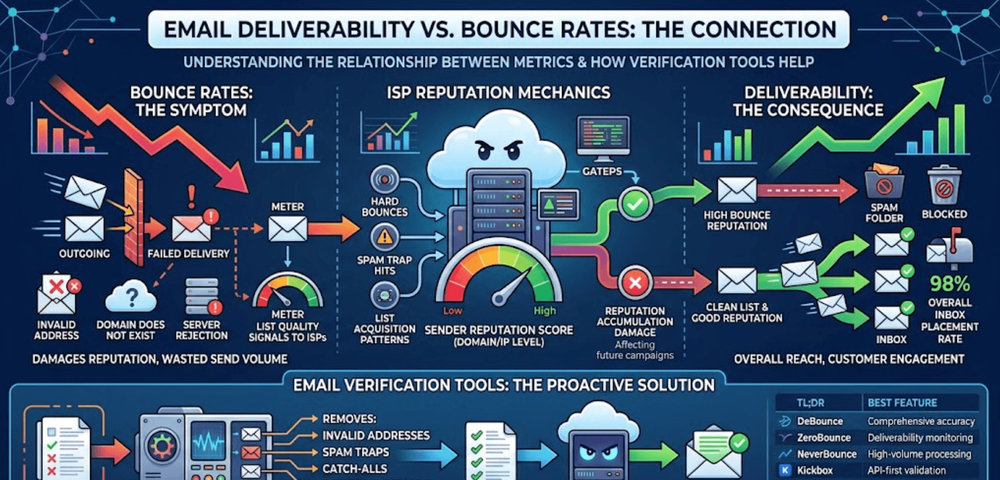
Email deliverability and bounce rates are connected metrics - but they are not the same thing, and understanding the relationship between them is the most useful framing for evaluating which email verification tool most effectively addresses your specific email performance challenge.
Bounce rates are a direct and measurable symptom: the percentage of sent emails that fail to reach the recipient's inbox because the address is invalid, the domain does not exist, or the receiving server rejects the message. High bounce rates are a problem in their own right - they represent wasted send volume and direct signal to ISPs that your list quality is poor.
Deliverability is the broader consequence: the overall inbox placement rate that determines whether your emails reach recipients at all. Bounce rates damage deliverability by generating the ISP reputation signals - specific patterns of message rejection that ISPs use to evaluate sender quality - that cause subsequent emails to be routed to spam folders or blocked entirely, even for valid addresses on clean lists.
Email verification tools address both simultaneously by removing the invalid, disposable, and risky addresses that produce bounces before those addresses generate the reputation damage that affects deliverability. The difference between tools is in how comprehensively they identify each category of problematic address, how efficiently they process lists at different volumes, and what additional capability they provide alongside core verification.
TL;DR - Best Picks
| Tool | Bulk Verification | Real-Time API | Specialisation | Best For |
|---|---|---|---|---|
| DeBounce | Yes | Yes | Comprehensive accuracy | Marketers, ecommerce, SaaS |
| ZeroBounce | Yes | Yes | Deliverability intelligence | Deliverability monitoring |
| NeverBounce | Yes | Yes | High-volume processing | Large database management |
| Kickbox | Yes | Yes | API-first validation | Developer integration |
| BriteVerify by Validity | Yes | Yes | Enterprise data quality | Enterprise organisations |
| Verifalia | Yes | Yes | Customisable workflows | Flexible verification needs |
| Emailable | Yes | Yes | Processing speed | Fast list turnaround |
How Email Verification Produces Deliverability Improvement
The deliverability improvement that email verification produces works through ISP reputation mechanics that are worth understanding precisely - because imprecise understanding leads to underestimating how consequential list hygiene is for inbox placement.
ISPs evaluate sender reputation at the domain and sending IP level, using signals accumulated across all sending behaviour rather than evaluating each campaign independently. Hard bounces from invalid addresses accumulate as negative reputation signals that persist across subsequent campaigns - which means unverified lists with high invalid address rates damage deliverability not only for the campaigns that generated the bounces but for every subsequent campaign sent from the same domain.
Spam trap hits - addresses that have been converted to monitoring addresses by ISPs or anti-spam organisations - are the most severe reputation signals, because they indicate either list acquisition practices that collect addresses without proper consent or list maintenance practices that allow addresses to age without hygiene. A sending domain that hits multiple spam traps can be blocklisted by major ISPs, producing deliverability failure across the entire subscriber base rather than only for the problematic segments.
Email verification removes both categories - invalid addresses and spam traps - before they can generate reputation damage, which is why consistent verification is more effective than reactive remediation after deliverability problems have already appeared.
7 Best Email Verification Tools for Improving Deliverability and Reducing Bounce Rates
1. DeBounce – Best for Email Verification Accuracy and Deliverability Improvement
DeBounce delivers the comprehensive multi-category email verification that meaningful deliverability improvement and bounce rate reduction require - identifying every class of problematic address that damages inbox placement, through both bulk list verification and real-time API validation, at the accessible pricing that makes consistent verification sustainable for businesses at any stage of growth.
The verification process addresses each category of address risk that contributes to deliverability damage. Hard bounces from invalid addresses - where the email address format is incorrect, the mailbox does not exist, or the domain has no active mail exchange - are identified through SMTP verification that confirms deliverability without sending an actual message. Spam trap addresses are detected through DeBounce's continuously updated database and pattern recognition, identifying the monitoring addresses that ISPs and anti-spam organisations have seeded across the web and that generate the most severe reputation penalties. Disposable email addresses from temporary email services are caught before they inflate list metrics with low-engagement addresses that damage inbox placement through behavioural signals alongside bounce signals. Catch-all addresses from domains that accept all incoming mail regardless of address validity are flagged for risk-based decision-making rather than treated as confirmed deliverable. Duplicate addresses that distort engagement metrics and create misleading deliverability signals are identified and consolidated.
Real-time API validation at the point of contact capture prevents invalid addresses from entering databases in the first place - reducing the bulk verification burden by maintaining list quality continuously rather than allowing quality to degrade between periodic cleaning passes. The combination of real-time prevention and periodic bulk cleaning produces the most consistent deliverability protection across the full email programme lifecycle.
Key Differentiator: Best for improving email list quality and sender reputation - combining comprehensive multi-category verification, real-time API validation, and integrations with major email marketing platforms in an accessible pricing structure that makes consistent list hygiene sustainable for growing businesses
2. ZeroBounce – Best for Deliverability Monitoring
ZeroBounce extends email verification into the broader deliverability intelligence category - combining address-level list cleaning with inbox placement testing, sending IP monitoring, and blacklist checks that reveal deliverability infrastructure issues that verification alone cannot address. For email programmes where deliverability challenges extend beyond list composition into domain reputation, sending IP health, or authentication configuration gaps, ZeroBounce's diagnostic tools provide the most comprehensive available view of what is actually limiting inbox placement.
The most practically useful application for ZeroBounce is when verification alone has not resolved persistent deliverability problems - indicating that the root cause may be infrastructure or reputation rather than list quality. ZeroBounce's inbox testing and blacklist monitoring help identify those alternative causes and guide the remediation that verification cannot provide.
Key Differentiator: Top-rated for deliverability monitoring and email intelligence - combining address verification with inbox placement testing, blacklist monitoring, and sender reputation tools for businesses whose deliverability challenge spans both list quality and sending infrastructure
3. NeverBounce – Best for High-Volume Email List Cleaning
NeverBounce's processing infrastructure is specifically built for the volume and automation requirements that businesses managing large and rapidly growing email databases need. The platform's ability to process bulk verification at the scale of millions of addresses without the processing time penalties that high-volume list management would otherwise require makes it the most capable option for businesses whose primary verification challenge is operational scale rather than feature depth.
Automation capabilities allow list cleaning to happen continuously as part of marketing workflows - preventing the quality degradation between periodic cleaning passes that produces the bounce rate spikes that damage deliverability in high-growth email programmes.
Key Differentiator: Best for high-volume email list verification and marketing automation integration - providing the processing scale and automation depth that businesses managing large and rapidly growing contact databases require for continuous list hygiene
4. Kickbox – Best for API-First Real-Time Verification
Kickbox is specifically designed around real-time point-of-capture validation - verifying email addresses during form submissions, account registrations, and checkout flows before invalid addresses enter a database and require subsequent bulk remediation. The API's response architecture and the nuanced Sendex quality score it provides enable sophisticated point-of-capture validation logic - allowing businesses to block clearly invalid addresses while making informed, risk-calibrated decisions about addresses in the uncertain middle range.
For businesses building the most preventive possible email hygiene infrastructure, Kickbox's real-time API combined with periodic bulk verification from a complementary platform addresses list quality at both the prevention and remediation stages.
Key Differentiator: Best for API-first real-time email validation at point of contact capture - with quality scoring that enables more nuanced point-of-capture validation decisions than binary valid/invalid rules permit
5. BriteVerify by Validity – Best for Enterprise Email Verification
BriteVerify by Validity provides the enterprise data quality and governance infrastructure that organisations managing complex multi-source customer databases require. The Validity platform's broader data integrity capabilities complement email verification with the compliance management, data governance, and multi-source database management that enterprise-scale customer data operations require alongside address-level verification accuracy.
For organisations at enterprise scale - where email database management spans multiple business units, regions, and sending domains - BriteVerify's enterprise integration infrastructure and Validity's data quality ecosystem provide the most complete available solution for the governance and deliverability management complexity that scale creates.
Key Differentiator: Best for enterprise email verification and customer data quality - providing the integration depth, governance infrastructure, and processing capability that enterprise organisations managing complex multi-source customer databases require
6. Verifalia – Best for Customisable Verification Workflows
Verifalia serves businesses whose email verification requirements are specific enough to benefit from the customisation flexibility that standard verification platforms may not adequately address. The platform's configurable validation settings - including custom quality thresholds, classification granularity adjustments, and specific handling rules for edge-case address categories - allow verification workflows to be tuned to the specific risk tolerance and use case of each business rather than operating on universally applied defaults.
For email programmes where standard verification classifications produce too many borderline cases that require manual review, Verifalia's classification flexibility allows those edge cases to be handled systematically through rules-based automation rather than through case-by-case human judgement.
Key Differentiator: Best for customisable email verification workflows - providing the configurable validation settings and classification granularity that businesses with specific or complex verification requirements need to tune list hygiene processes to their precise risk tolerance and use case
7. Emailable – Best for Speed and Fast List Cleaning
Emailable delivers high-speed email list verification for businesses whose primary verification requirement is processing efficiency - the ability to clean large lists quickly without the processing time that slower verification platforms require. For businesses managing time-sensitive list cleaning needs - pre-campaign verification under deadline, rapid database cleanup before a major send, or high-frequency verification cycles for programmes with fast list growth - Emailable's processing speed is the most directly relevant platform capability.
The accessible pricing alongside speed-optimised processing makes Emailable particularly practical for businesses that need fast list turnaround at cost structures that make frequent verification cycles financially sustainable.
Key Differentiator: Best for fast email list cleaning and quick turnaround - providing high-speed bulk verification processing for businesses with time-sensitive list hygiene needs or high-frequency verification requirements
Choosing the Right Email Verification Tool for Your Deliverability Goals
The email verification tool that produces the strongest deliverability improvement and bounce rate reduction is the one whose accuracy, processing capability, and additional features most directly match the specific deliverability challenge being addressed.
For businesses that need comprehensive multi-category verification covering all address risk types alongside real-time API validation in an accessible scalable pricing structure, DeBounce provides the most complete combination for that profile. For those whose deliverability challenges extend beyond list quality into infrastructure and reputation diagnostics, ZeroBounce's monitoring tools are most relevant. For those processing large volumes where operational scale and automation are primary requirements, NeverBounce's infrastructure depth is most capable.
For businesses prioritising point-of-capture prevention through real-time API integration, Kickbox's API-first architecture is most directly designed for that use case. For enterprise organisations managing complex multi-source customer databases at governance scale, BriteVerify provides the most complete enterprise solution. For businesses with specific workflow requirements that standard platforms do not adequately address, Verifalia's customisation flexibility is most applicable. For those whose primary requirement is processing speed and fast list turnaround, Emailable's speed-optimised design is most directly relevant.
FAQ
Why do bounce rates damage email deliverability beyond just the bounced messages?
Hard bounces signal to ISPs that the sending domain is generating mail to non-existent addresses - which ISPs interpret as either poor list acquisition practices or poor list maintenance. Those signals accumulate in sender reputation scoring at the domain level, causing ISPs to apply increasing scepticism to all subsequent mail from the domain. A domain with a persistent pattern of high bounce rates will see inbox placement rates decline across the entire subscriber base - not only for the invalid addresses that generated the bounces. Email verification prevents that reputation accumulation by removing invalid addresses before they generate bounce signals.
How often should businesses run email verification to maintain deliverability?
Active marketing lists should be verified at minimum every three to six months, with more frequent cycles for programmes with high acquisition volume through multiple sources. Lists that have not been mailed in six or more months should always be verified before reactivation - dormant addresses convert to spam traps at a higher rate than actively mailed addresses. Real-time API validation at contact capture points reduces but does not eliminate the need for periodic bulk verification, because even initially valid addresses become invalid as contacts change providers or abandon accounts over time.
What is the difference between hard bounces and soft bounces for deliverability purposes?
Hard bounces indicate permanent delivery failure - the address does not exist, the domain has no mail server, or the receiving server has permanently rejected the sender. These are the most damaging for sender reputation and should be removed from lists immediately. Soft bounces indicate temporary delivery failure - the recipient's mailbox is full, the receiving server is temporarily unavailable, or the message was too large. Soft bounces do not generate the same reputation signals as hard bounces and the associated addresses typically recover their deliverability. Email verification specifically addresses hard bounce prevention through validation of address existence, domain validity, and mailbox status.
Can email verification fully prevent deliverability problems?
Email verification addresses the list quality dimension of deliverability - which is significant but not the only factor affecting inbox placement. Authentication configuration, sending volume and cadence, engagement rate patterns, content quality, and sending infrastructure health all contribute alongside list hygiene. Businesses that verify consistently but have authentication gaps, suppressed engagement rates, or content quality issues affecting spam filter scoring may still experience deliverability challenges that verification alone cannot resolve. Comprehensive deliverability management addresses all of those dimensions, with email verification as the foundational list quality investment that makes the others more effective.