Proxy Servers as Part of Your Anti-Tracking Toolkit

Spybroski Team
Proxy Servers as Part of Your Anti-Tracking Toolkit
Modern internet marketing and web analytics require constant work with large volumes of open data without exposing working algorithms. Search engines and commercial websites record every user action, collect digital profiles, and limit automated requests. To conduct research and analyze competitors, experts use specialized proxy servers that optimize the collection of publicly available information and mitigate external monitoring. The professional use of intermediary addresses enables effective market research without the risk of digital tracking.
Why Proxy Servers Are the Foundation for Public Information Analysis
Protecting the information space goes beyond relying on physical devices alone. In addition to purchasing physical GPS tracker detectors, users also need digital tools to protect their online activity. Professional anti-surveillance tools include both hardware solutions and software tools.
Analysts and ordinary users encounter the tracking of their digital footprints daily while browsing websites. Special algorithms form a unique digital portrait of the user by capturing:
- browser parameters,
- operating system,
- time zone,
- computer's geolocation.
Large companies actively use automation tools to monitor competitors' prices daily. Special search bots collect public info, such as:
- price lists,
- product descriptions,
- tech specifications,
- promotional offers.
To avoid technical failures during such mass requests, companies use stable intermediate servers. This makes it possible to continuously collect information without overloading the target web resources.
That's why IP address masking is a necessary step to prevent third-party trackers and analytics platforms from collecting information. Modern online safety is based on a comprehensive approach to maintaining the confidentiality of work processes. Specialized proxy servers replace the real device's address with that of an intermediate server in another location. Such residential IP routing complicates the work of analytical scripts that try to link your requests into a single session.
Corporate users implement various anti-tracking practices to protect their commercial interests and intellectual property. They combine hardware tools, such as anti-tracking measures, with modern software platforms. Researchers use this counter-surveillance technology to audit advertising campaigns and check landing pages.
How to Properly Choose Proxy Servers for Auditing Digital Platforms
To conduct a quality audit of web resources, specialists use proxy servers of various classes. The correct choice of connection type guarantees high request processing speed and stable collection.
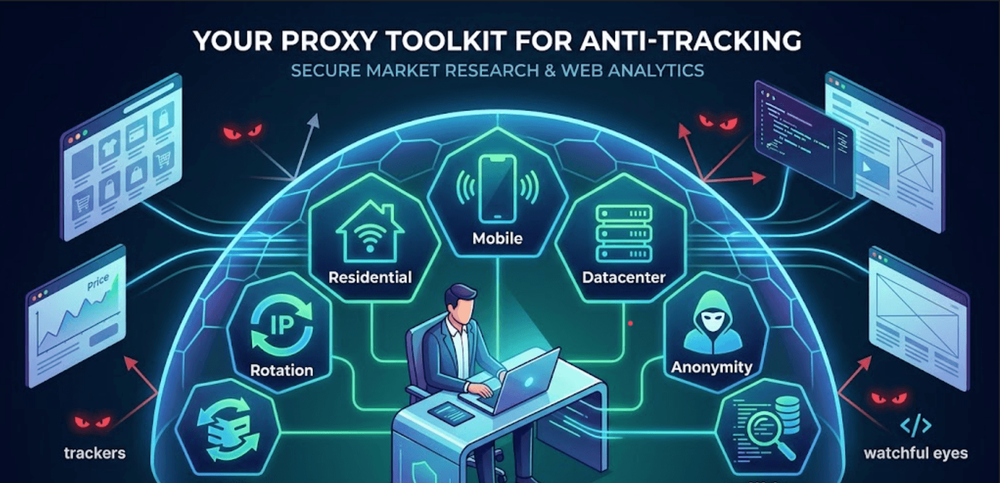
Experts identify several main categories of proxies for solving professional tasks:
- Residential IPs belong to real home providers and users. For example, the Proxy-Seller service provides access to a pool of such addresses that ensure the highest level of trust with target web resources when collecting public information.
- Mobile IPs are assigned from a pool provided by mobile network operators. Mobile proxies have a dynamic nature and help you with your marketing research and testing of different mobile website versions.
- Datacenter IPs are located on large servers and in cloud storage. These offer the highest speeds, but their trust level is low because they use fixed subnet ranges.
Pay attention to the rotation features provided by top vendors. You may set up automatic IP rotation for every new request, or set an interval between rotations.
Every type has its pros and cons and works better than others for certain tasks. When dealing with large amounts of data, connection speed and signal delay to the target server matter a lot. In such a case, datacenter solutions beat other types; however, residential offers the right balance of reliability for competitor studies. Marketers combine these types to get the best results while saving on prices.
Using intermediary nodes requires strict compliance with applicable laws and ethical standards. Specialists collect only publicly available information on the Internet. Leading services guarantee confidentiality for their corporate customers.
Technical Protocols and Proxy Servers in Modern Web Scraping
Modern users prefer quick solutions that provide fast connectivity. Basic operations are possible via SOCKS5 and HTTP proxies, which work on different layers of the OSI model. The first handles web-specific traffic, whereas the second can transmit any data packets. For more advanced data collection needs, businesses can also rely on a web scraping service to gather publicly available information efficiently.
While basic operations are possible via SOCKS5 and HTTP proxies, understanding VPN vs proxy helps clarify the differences in encryption and anonymity protocols. For full-tunnel encryption rather than per-request routing, services like AstrillVPN are a common complement to proxy pools — encrypting all outbound traffic at the device level while proxies rotate IPs at the request level.
If you want to investigate restricted corporate sites, employ encrypted communication channels. It will make anonymous browsing techniques harder to track.
Modern developers often include proxy servers directly in their code to streamline public info collection. It simplifies interaction with sites and makes networking more efficient. Properly set-up protocols ensure there are no holdups or connection failures when making requests.
Practical Integration Into Automation Systems
Webmasters use proxies with their scripts, cloud services, anti-detect browsers, and headless browsers. All that minimizes the risks of blocks and stabilizes the work.
Anti-detect browsers use fingerprint protection methods, replacing real PC technical data with generated digital profiles. This process masks Canvas, WebGL, audio fingerprints, and hardware configuration parameters. Combined with this software, proxy servers provide a fully functional testing ground for marketing hypotheses.
AI developers also actively use these tools. They set up middle IPs to harvest huge text arrays and train neural networks. That needs millions of back-to-back requests to open libraries and encyclopedias. Without a decent pool of IPs, bots quickly get throttled by request rate limits.
Economic Analysis and Price Plans
During project scaling, a key factor here is provider trust and reputation in the service market. Professional teams carefully examine volumes of addresses in pools and the purity of the residential traffic collection in accordance with the law. Nowadays, the best proxy providers offer flexible tariffs based on traffic or the number of ports and guarantee compliance with international standards (GDPR, CCPA) when collecting public information.
To choose your supplier, here are average market prices for different types of connections:
| Proxy type | Average cost | Connection features |
|---|---|---|
| Residential | $2.00 - $3.50 per 1 GB | Payment for traffic, high level of trust |
| Mobile | $15.00 - $25.00 per week | Unlimited traffic, time-based rotation |
| Datacenter (IPv4) | $1.20 - $1.80 per 1 IP | High speed, fixed IP |
Project budgeting is based on planned traffic volume and address rotation frequency. For small studies with low data consumption, PPGB residential proxies are the most economical option. Large marketing agencies prefer bundled packages with unlimited mobile ports, allowing cost savings while maintaining workflow efficiency.
Conclusions and Next Steps for Tool Configuration
Intermediate IP addresses are commonly used for modern web analytics and marketing research. Quality proxy servers ensure the seamless collection of public data while protecting your working algorithms from external monitoring. The combination of residential addresses and professional software will provide you with a solid foundation for scaling your business processes. Choose reliable providers with an impeccable reputation to achieve consistent results in research.