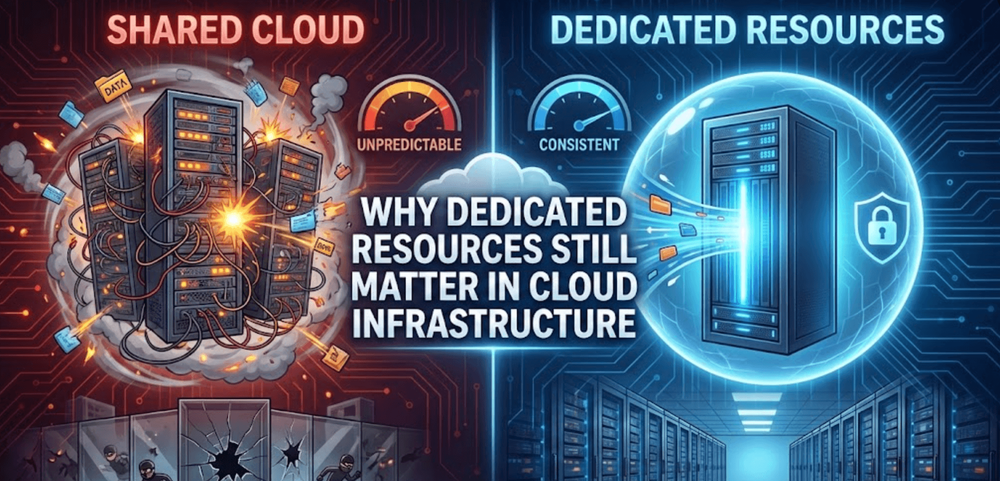
Why Dedicated Resources Still Matter in Cloud Infrastructure

Spybroski Team
Shared cloud environments dominate modern IT conversations. Companies rush toward multi-tenant solutions, chasing cost savings and flexibility. But something gets lost in that migration: control over performance and security.
The 2024 Flexera State of the Cloud Report found that 82% of enterprises now run hybrid strategies. They're not abandoning shared resources entirely, but they're carving out dedicated space for workloads that demand consistency. This trend reflects a maturing understanding of infrastructure economics.
The Performance Predictability Problem

Shared infrastructure operates on a simple premise: pool resources, distribute costs. That math works beautifully until 3 PM on a Tuesday when a neighboring tenant spins up a massive data processing job. Suddenly, your carefully optimized application slows to a crawl.
Noisy neighbor syndrome costs businesses real money. A financial services firm processing trades can't afford 200ms latency spikes during market hours. An e-commerce platform during Black Friday needs guaranteed throughput, not theoretical maximums based on best-case scenarios.
Dedicated resources eliminate this variability entirely. When a server belongs exclusively to one organization, performance becomes predictable down to the millisecond. The CPU cycles, memory bandwidth, and network capacity all serve a single master. Companies running dedicated proxies for web operations understand this principle intimately (the same logic applies across infrastructure categories).
Tools like BlueTally further help IT teams monitor hardware and software assets across their infrastructure, ensuring consistency, compliance, and optimal resource allocation.
Security Isolation Goes Deeper Than You Think
Multi-tenant security has improved dramatically over the past decade. Cloud providers invest billions in hypervisor hardening and network segmentation. Yet certain threat vectors remain stubbornly present in shared environments.
Side-channel attacks exploit shared physical hardware at the processor level. Researchers at MIT demonstrated that attackers can extract cryptographic keys from neighboring virtual machines under specific conditions. The risk probability stays low, but consequences for affected organizations can be severe and long-lasting.
Compliance requirements often mandate physical separation regardless of technical controls. Healthcare organizations handling patient records, financial institutions processing transactions, and government contractors managing classified data frequently require dedicated infrastructure. Their auditors don't accept "virtually isolated" as equivalent to "physically separate" when certification is on the line.
When Shared Makes Sense (And When It Doesn't)
Development environments rarely need dedicated resources. Testing servers, staging platforms, and internal tools operate perfectly well on shared infrastructure. The cost savings here are genuine and worth capturing.
Production workloads tell a different story. According to Gartner's research, organizations running mission-critical applications on dedicated infrastructure report 34% fewer performance-related incidents. That reduction translates directly into customer satisfaction scores and revenue protection.
Database servers particularly benefit from dedicated allocation. Query performance depends heavily on consistent I/O throughput. A database competing for disk access with unknown workloads produces unpredictable response times. Applications built atop that database inherit the inconsistency.
Similarly, engineering teams executing large-scale browser automation suites via a cloud playwright browser often prefer isolated environments to ensure deterministic rendering, stable network conditions, and reliable execution timing.
The Hidden Cost Calculation
Dedicated resources carry higher sticker prices. That's undeniable. But the calculation requires examining total cost of ownership rather than hourly rates alone.
Engineering time spent troubleshooting intermittent performance issues adds up quickly. A senior developer earning $180,000 annually who spends 10% of their time chasing cloud-related gremlins represents $18,000 in hidden costs. Multiply that across a team, and dedicated infrastructure starts looking economical.
Customer churn from reliability problems compounds the equation further. B2B SaaS companies losing enterprise clients over availability concerns face revenue impacts dwarfing any infrastructure savings.
Hybrid Approaches Winning in Practice

Smart organizations aren't choosing between shared and dedicated anymore. They're mixing both based on workload characteristics. Understanding how to balance these infrastructure models is also valuable for professionals pursuing a cloud computing certification.
Stateless web servers handling variable traffic? Shared auto-scaling groups work beautifully there. The payment processing engine those servers call? That runs on dedicated hardware with guaranteed resources.
This tiered approach optimizes both cost and performance. Harvard Business Review's analysis of technology infrastructure decisions found that companies taking nuanced approaches outperformed those applying blanket policies. Context matters more than ideology.
Making the Transition Thoughtfully
Organizations currently running entirely on shared infrastructure shouldn't panic or rush into expensive migrations. Most workloads genuinely perform fine in multi-tenant environments, and the cost benefits remain real.
Start by identifying the 10-15% of systems where performance variability creates measurable business impact. Those candidates deserve dedicated resource evaluation first. Run parallel tests comparing behavior under load, track the metrics carefully, and let the data guide decisions rather than assumptions.
The cloud infrastructure conversation has matured beyond simple either/or framing. Dedicated resources aren't relics of an outdated era or expensive luxuries. They're precision tools serving specific purposes in a broader toolkit that smart organizations assemble thoughtfully. Companies treating them as such will build more resilient, more performant systems than competitors chasing one-size-fits-all solutions.