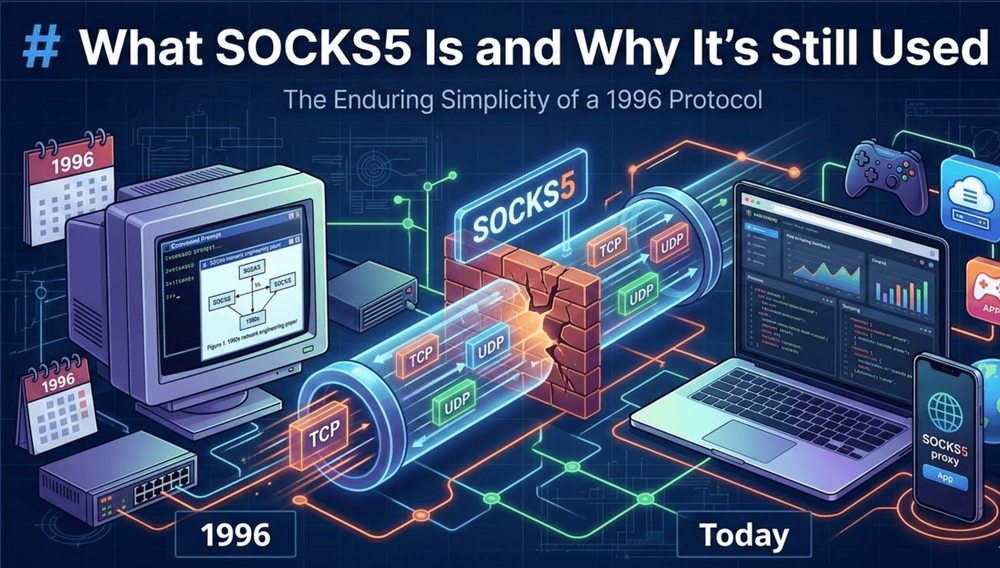
What SOCKS5 Is and Why It's Still Used

Spybroski Team
What SOCKS5 Is and Why It's Still Used
A protocol from 1996 shouldn't still be relevant. And yet here we are: SOCKS5 remains the preferred choice for developers, data teams, and anyone routing traffic through proxies who doesn't want to deal with protocol restrictions.
What keeps this thing alive when we've got newer, shinier alternatives? Turns out, doing one job well never goes out of style.
How SOCKS5 Actually Works
SOCKS5 sits at Layer 5 of the OSI model, wedged between applications and the transport layer. That positioning matters because the protocol genuinely doesn't care what you're sending through it.
Your device connects to a SOCKS5 server, completes a quick handshake (with optional authentication), and the server opens a relay to wherever you're trying to reach. Packets flow through without getting inspected or rewritten along the way.
HTTP proxies only understand web traffic. SOCKS5 handles TCP and UDP for pretty much anything: email clients, FTP, games, VoIP. No special configuration needed on the application side.
The Technical Edge Over Other Protocols
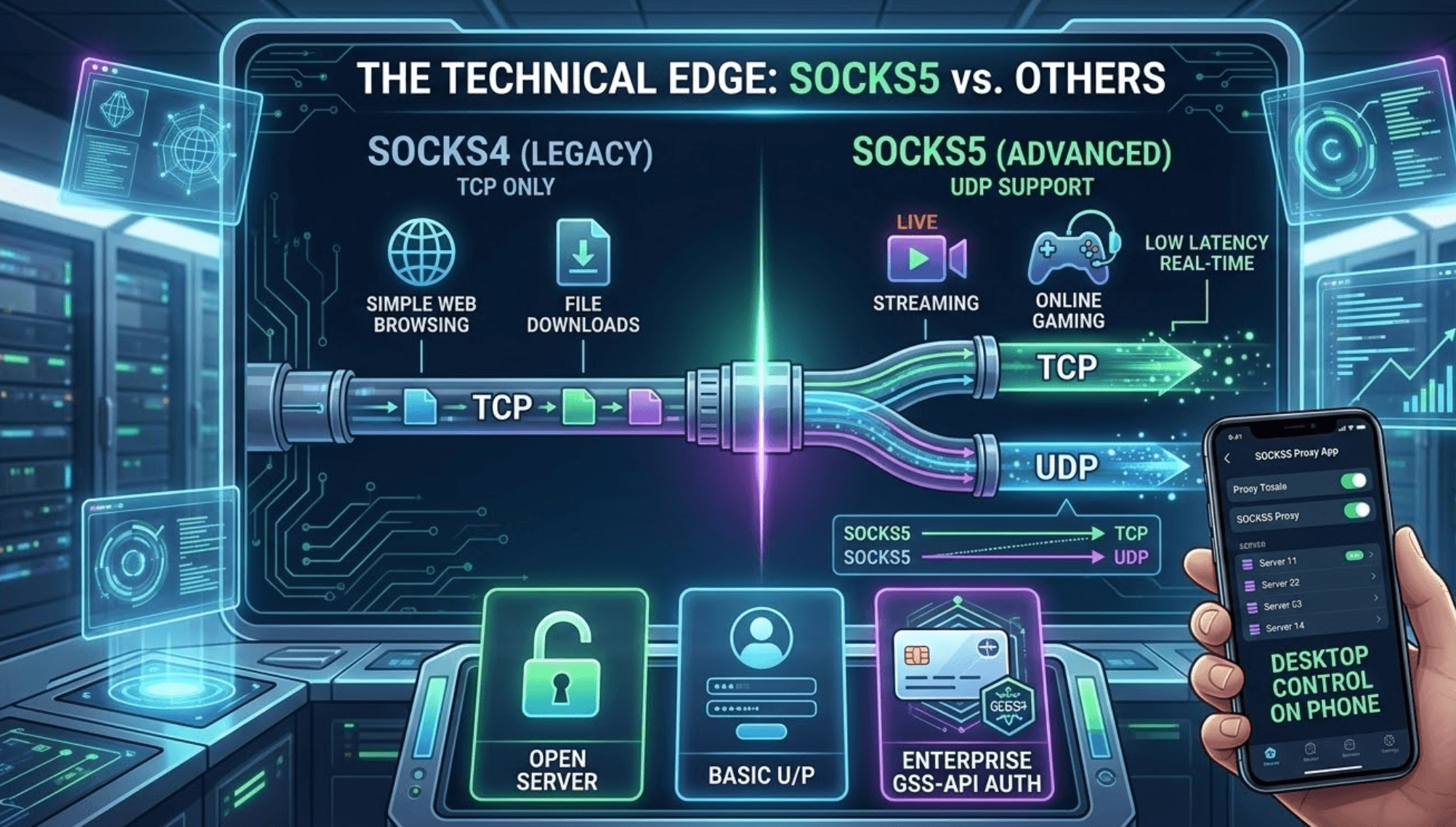
SOCKS4 could only do TCP. When version 5 dropped, it added UDP support, and that changed the game for real-time stuff like streaming and online gaming where latency kills the experience.
The protocol also brought multiple authentication options to the table. You can run open servers, use basic username/password setups, or go full enterprise with GSS-API auth. Mobile users can configure connections through an iphone socks5 proxy app, which brings the same proxy control you'd expect on desktop to your phone.
The IETF's RFC 1928 specification spells out the original design goals: give applications a general framework for getting through firewalls without needing to understand the security setup underneath. Simple concept, executed well.
Why Businesses Still Choose SOCKS5
Speed is the short answer. SOCKS5 doesn't parse your data or run content filters, so it adds almost nothing to your latency. Real-world tests show the protocol handling thousands of connections simultaneously with response times in the single-digit milliseconds.
Web scraping teams live on SOCKS5 for exactly this reason. When you're making 50,000 requests an hour, you can't afford extra overhead from chatty proxy protocols.
E-commerce operations use it to track competitor pricing globally. TCP and UDP support means they scrape traditional pages while also testing WebSocket features, all through the same proxy infrastructure.
The Privacy Angle
Every proxy hides your IP. That's table stakes. SOCKS5 goes a bit further by not touching packet headers or injecting metadata that could identify you. Less fingerprinting surface compared to HTTP proxies that love adding their own headers.
Here's the catch though: SOCKS5 doesn't encrypt anything on its own. Cloudflare's engineers pointed this out in their technical overview of proxy protocols, noting that SOCKS runs cleartext by default. The workaround is pairing it with SSH tunneling or just routing traffic that's already encrypted (HTTPS) through the proxy.
Common Use Cases Today
QA teams spin up SOCKS5 proxies to test how their apps behave for users in different countries. Developers in Berlin can verify the Tokyo experience without booking flights.
Gaming companies test multiplayer server performance across regions before launch. They need real latency numbers from actual geographic locations, not simulations run in a lab somewhere.
Market research firms pull region-locked content for sentiment analysis. Remote workers hit internal company systems through SOCKS5 when a full VPN feels like overkill for what they need.
The Protocol's Staying Power
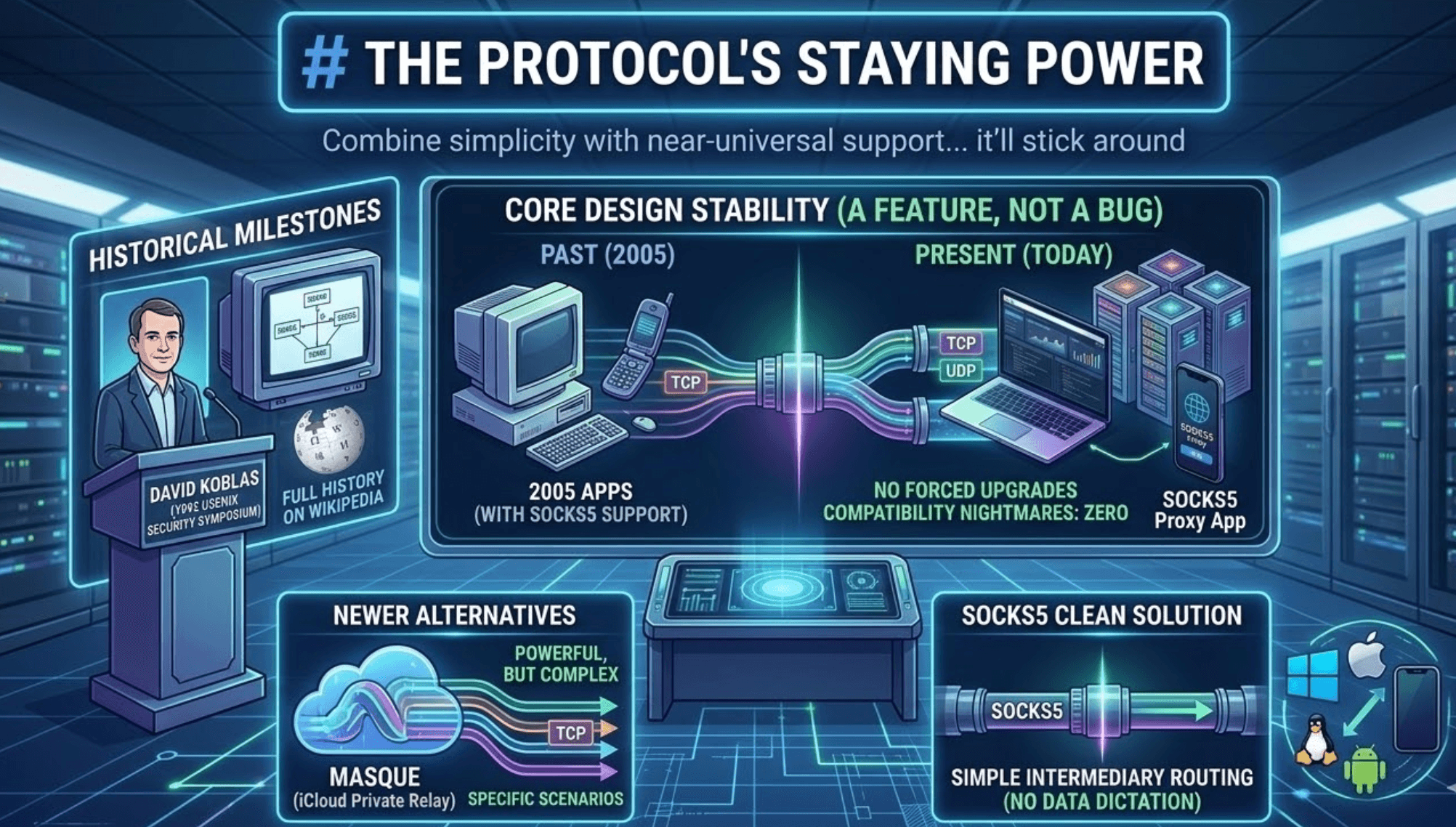
David Koblas created SOCKS at MIPS Computer Systems and presented it at the 1992 USENIX Security Symposium. Wikipedia's entry on SOCKS has the full history if you're curious. The wild part? The core design hasn't changed much since.
That stability is a feature, not a bug. Apps that added SOCKS5 support in 2005 still work fine with today's proxy servers. No version headaches, no compatibility nightmares, no forced upgrades.
Newer stuff like MASQUE (powering iCloud Private Relay) handles specific scenarios better. But those protocols bring complexity that most use cases don't need.
SOCKS5 solves one problem cleanly: route traffic through an intermediary without dictating what that traffic should look like. Combine that simplicity with near-universal client support across operating systems, and you've got a protocol that'll stick around for a while yet.