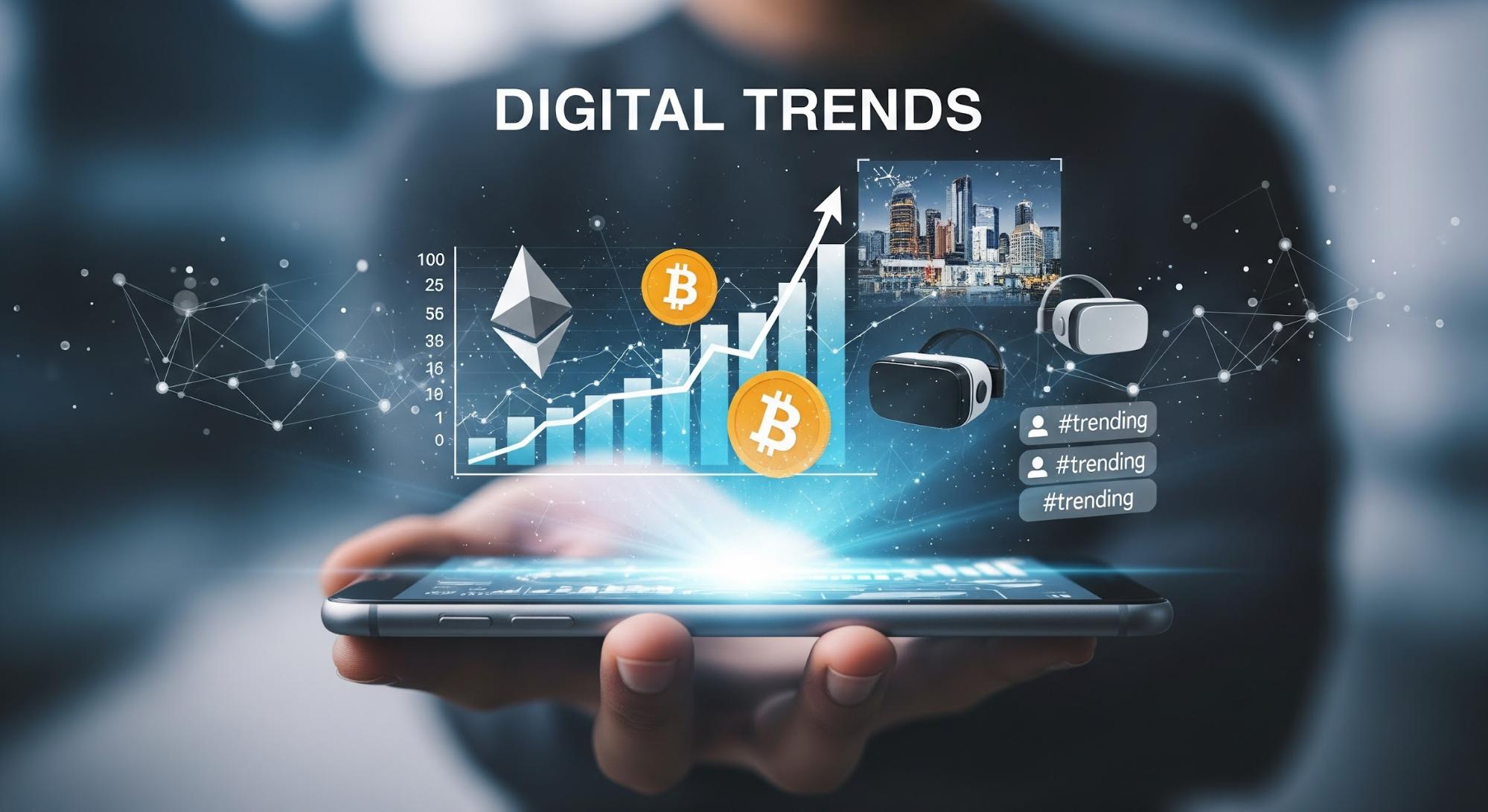
Top Digital Trends Transforming Business and Investment in the Tech-Driven Era

Spybroski Team
Top Digital Trends Transforming Business and Investment in the Tech-Driven Era
Introduction
We’re living in a world that’s moving faster than ever, and it’s all thanks to one thing: technology. Whether you're a business owner trying to stay ahead of the competition or an investor chasing the next big opportunity, the digital landscape is where everything is happening. From AI-driven automation to breakthrough innovations like quantum computing, digital trends are reshaping how we work, market, scale, and invest.
It’s not just about hopping on the latest trend—it’s about understanding how these innovations fit into a long-term strategy. Businesses that adopt cutting-edge tools are outpacing their competition, and investors who recognize rising tech early are seeing exponential returns.
In this article, we’ll break down the top digital trends that are transforming business operations and investment strategies.Let’s dive into the future—today.
The Digital Shift: How Tech Is Reshaping Business and Investment
We’re not just witnessing a shift—we’re experiencing a complete transformation. What used to take decades now happens in a matter of months. Businesses that relied on traditional models are going digital, while investors are pouring billions into technology-driven assets.
COVID-19 accelerated digital adoption, forcing businesses to rethink their models. Remote work, e-commerce, cloud computing—these were optional before 2020. Now, they’re non-negotiable. As companies adapted, so did investors, looking beyond oil, real estate, or manufacturing, and betting big on digital-first industries.
This kind of transformation is also reflected in how professionals communicate today. Instead of jumping straight into sales-heavy outreach, many teams start with warm up emails, simple, value-driven messages that spark conversation without pushing an agenda. These emails focus on shared observations, industry shifts, or trends, helping build trust and credibility before any business discussion takes place.
This digital shift has two sides. On one hand, businesses need to digitize to survive. On the other, investors are hunting for the next Amazon or Tesla in the tech space. Trends like automation, AI, cloud services, and blockchain are no longer “emerging”—they’re here, and they’re reshaping everything.
AI and Machine Learning: Automating Success
Artificial Intelligence (AI) and Machine Learning (ML) aren’t just buzzwords—they’re the brains behind modern business efficiency. Today, AI is doing everything from analyzing customer behavior to automating operations and predicting trends. Professionals looking to build deeper expertise in these technologies can also explore an ai ml course
Businesses are leveraging AI to streamline support through chatbots, analyze massive data sets for insights, and personalize marketing efforts. To manage databases more efficiently, enterprises often adopt AI-driven analytics platforms like Lumi AI to simplify data exploration and decision-making. E-commerce giants like Amazon use AI to recommend products, adjust pricing in real-time, and optimize logistics. Even small startups are tapping into AI tools like AI Interview Helper to improve their workflows and customer service.
Sales is no exception. AI-powered SDRs are now taking over repetitive outbound tasks like lead research, first-touch outreach, follow-ups, and qualification. Instead of manual prospecting, companies can deploy AI SDR systems that engage leads across email, LinkedIn, and other channels simultaneously, at scale and with consistent messaging. Platforms like AnyBiz use AI SDRs to help sales teams focus on closing deals while the AI handles pipeline generation 24/7.
On the investment front, companies integrating AI are being watched closely. Investors see AI as a long-term growth engine, and early-stage startups with solid AI capabilities are receiving huge funding rounds. For those building that foundation internally, Future Processing's AI strategy adoption framework helps companies move from isolated AI experiments to organisation-wide implementation with measurable ROI targets built in. For stockholders, AI is not just a theme—it’s a foundational tech.
It’s safe to say that in the near future, companies not using AI will struggle to compete. And those investing in AI-backed ventures may see significant returns.
SaaS: The Digital Backbone of Modern Businesses
Software-as-a-Service (SaaS) has quietly taken over the business world. Instead of buying expensive software licenses, businesses now subscribe to tools they can access from anywhere. That’s SaaS in a nutshell—flexible, scalable, and cost-effective.
However, as companies adopt dozens of these cloud applications across different departments, implementing a dedicated SaaS management strategy becomes crucial to tracking active subscriptions, controlling runaway expenditures, and securing company data
From collaboration tools like Slack and Zoom to CRM platforms like Salesforce and HubSpot, SaaS is powering businesses of all sizes.
As companies evaluate CRM solutions, reviewing a list of hubspot alternatives can help them identify tools that better align with their specific needs and budgets.
The recurring revenue model gives companies predictable income while providing constant updates and improvements for users. Plus, the low barrier to entry means even startups can get access to world-class tools.
The SaaS economy is massive. Analysts predict the global SaaS market could surpass $900 billion by 2030. That’s a big deal—not just for companies using these tools, but for investors seeking high-growth stocks. SaaS companies often enjoy high margins, loyal customers, and strong valuation multiples.
At the same time, the scale and accessibility of these platforms highlight the challenge of being "always on" in SaaS, where continuous availability and real-time expectations can strain both infrastructure and teams.
And when you combine SaaS with smart marketing? That’s where the magic really happens.

Google Ads for SaaS: Fueling Growth at Scale
Let’s get real—if you’re running a SaaS business and not using Google Ads for SaaS, you’re missing out. Period.
Why? Because SaaS is hyper-competitive. There’s always a new app or service popping up, and users are just a search away from switching to a competitor. Google Ads gives SaaS companies the visibility they need when it matters most—right when potential customers are searching for solutions, and it can work like a startup accelerator to grow your startup faster and more efficiently.
With Google Ads, SaaS businesses can target specific keywords that signal high purchase intent, like “CRM software for small business” or “best email marketing tools” You only pay when someone clicks, making it cost-effective and highly measurable.
Plus, Google Ads offers A/B testing, conversion tracking, and remarketing tools that help SaaS marketers fine-tune their campaigns. Want to acquire users quickly? Scale monthly recurring revenue (MRR)? Enter new markets? Google Ads delivers.
Many of today’s fastest-growing SaaS brands—think ClickUp, Monday.com, or Asana—leveraged Google Ads as part of their growth strategy. It’s not just about traffic; it’s about targeted, ROI-positive growth.
Big Data and Predictive Analytics: Powering Smarter Decisions
Data is the new oil, but it’s only useful when refined. That’s where big data and predictive analytics come in. They help businesses and investors turn raw numbers into actionable insights.
Companies use big data to understand customer preferences, predict buying behavior, and optimize operations. For example, a retail chain might use predictive analytics to determine the best time to launch a product or restock inventory. Meanwhile, healthcare firms analyze patient data to improve treatment outcomes.
Investors, too, are using data to gain an edge. Quant funds rely on data-driven models to trade stocks. Venture capitalists assess startup potential using growth metrics and user behavior patterns. In a world drowning in data, those who can extract meaning are the ones who win.
Cybersecurity: A Digital Lifeline
As businesses go digital, the risks multiply. Cybersecurity is no longer an afterthought—it’s mission-critical.
With more data being stored and transferred online, breaches can be catastrophic. Think customer info leaks, ransomware attacks, or financial data exposure. The cost of a data breach? On average, $4.45 million. For some businesses, that’s a death sentence.
That’s why companies are investing heavily in cybersecurity tools—firewalls, endpoint protection, intrusion detection systems, and robust data protection strategies to safeguard sensitive information and maintain customer trust.
From an investment perspective, cybersecurity is a high-growth sector. Companies like CrowdStrike, Palo Alto Networks, and Fortinet are seeing explosive growth. As more businesses digitize, the demand for protection will only grow.
Fintech: Reinventing How We Handle Money
The financial world has seen more disruption in the past five years than in the last fifty. Enter fintech—a sector built on convenience, transparency, and tech-powered efficiency.
From mobile banking apps to peer-to-peer lending platforms, fintech has made financial services accessible and user-friendly. Blockchain-based solutions, cryptocurrency, robo-advisors, and decentralized finance (DeFi) are reshaping how money flows.
Businesses benefit from faster transactions and easier access to credit. Consumers enjoy lower fees and better interfaces. And investors? They’re pouring billions into fintech startups and tracking the stock performance of firms like Square, PayPal, and Coinbase.
As financial ecosystems become more digital, fintech will continue to dominate headlines—and portfolios.
Quantum Computing: The Next Tech Frontier
Let’s talk about the future—literally. Quantum computing isn’t just a cool concept from a sci-fi movie. It’s the next evolution of processing power, and it could change everything.
Traditional computers use bits (0s and 1s). Quantum computers use qubits, which can represent multiple states at once. This means they can solve problems too complex for even the fastest supercomputers today.
Imagine drug discovery in hours instead of years. Climate modeling with pinpoint accuracy. Logistics systems that optimize global shipping in real-time. Quantum computing holds the key to breakthroughs we haven’t even imagined yet.
Right now, it’s early days. But the potential is massive. Businesses that get a head start on quantum R&D will lead the next wave of innovation. And that brings us to the investment side…
Quantum Computing Stocks: Investing in Tomorrow
If you’re a forward-thinking investor, Quantum Computing Stocks should be on your radar. These aren’t your typical blue-chip investments. They’re high-risk, high-reward bets on a technology that could redefine industries.
Companies like IonQ, D-Wave, and Rigetti are early players in the quantum space. Meanwhile, tech giants like IBM, Google, and Microsoft are heavily investing in quantum research. The market is still nascent, but it’s growing fast.
Investing now is like investing in the internet in the early 90s. Sure, some companies will fail—but the ones that succeed could become trillion-dollar titans. For tech-savvy investors with a long-term mindset, quantum computing could offer exponential returns.

Conclusion
The digital revolution isn’t coming—it’s already here. From how businesses operate to where investors put their money, tech trends are shaping the future in real-time. Whether you’re using Google Ads for SaaS to scale your startup or exploring Quantum Computing Stocks as your next bold investment, one thing’s certain: staying ahead in this tech-driven era means being informed, agile, and ready to act.
Embrace the change. Innovate. Invest wisely. Because the future belongs to those who adapt faster than the rest.
FAQs
1. What is the biggest digital trend right now for startups?
AI integration is currently the biggest trend. It’s being used in automation, customer support, marketing, and even product development.
2. How does Google Ads for SaaS differ from other industries?
SaaS businesses focus heavily on performance marketing with high LTV (lifetime value) and recurring revenue. Google Ads allows for hyper-targeted campaigns that drive scalable growth.
3. Are quantum computing stocks worth the risk?
Quantum stocks are high-risk, high-reward. They’re ideal for long-term investors who believe in transformative technology and are comfortable with market volatility.
4. How can small businesses compete in the digital transformation race?
By leveraging affordable SaaS tools, focusing on automation, and embracing digital marketing, small businesses can scale without massive budgets.
5. What are some top SaaS tools for digital marketing?
HubSpot, Mailchimp, SEMrush, and Google Ads are among the best SaaS tools for automating and scaling marketing efforts.