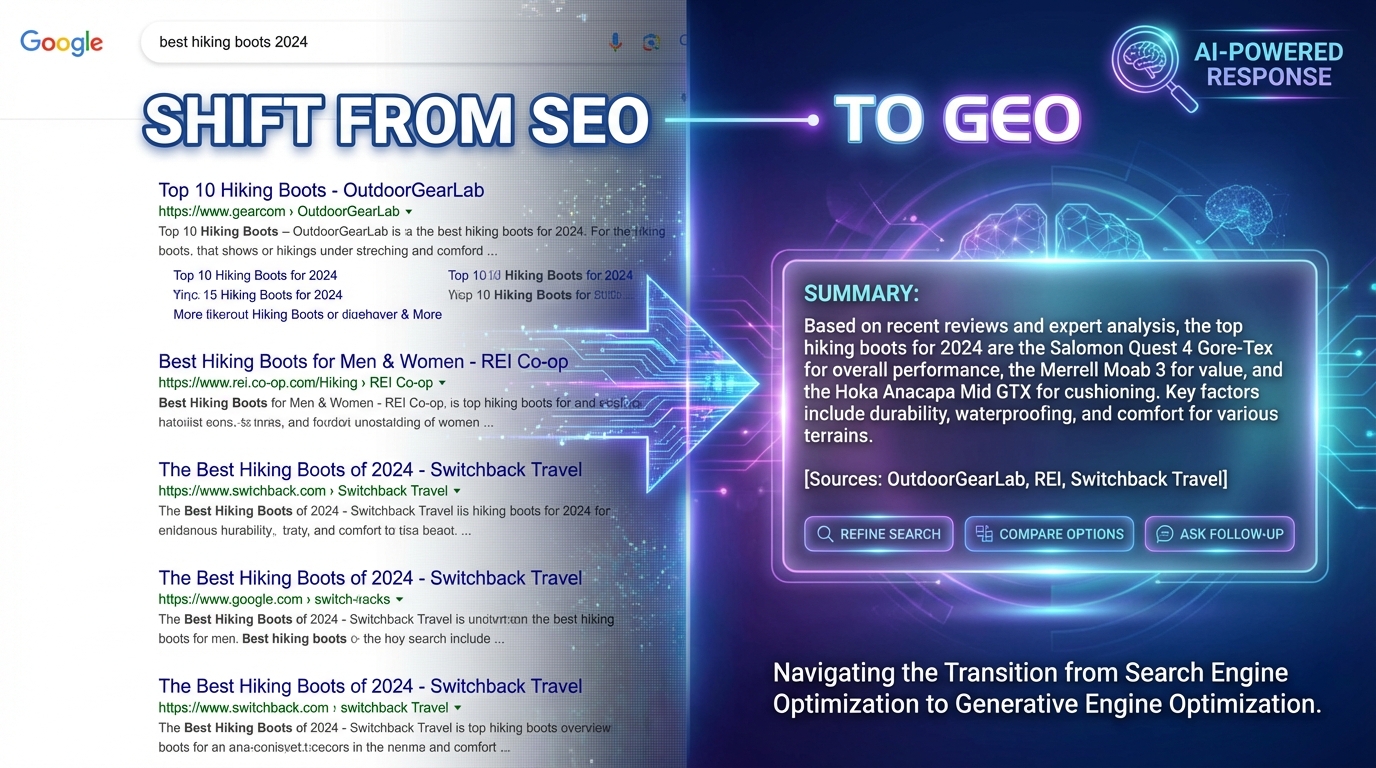
From SEO to GEO: How AI Is Reshaping Search and What It Means for You

Spybroski Team
If you've been doing digital marketing and SEO for a while, you've probably noticed something feels different lately. Rankings shift in strange ways. Traffic dips without a clear reason. And Google's search results page looks less like a list of links and more like... a conversation.
That's not a bug. It's the new reality.
Search is going through its biggest transformation since Google first launched. And if you're a marketer, content creator, or business owner, understanding the shift from traditional SEO to GEO (Generative Engine Optimization) isn't optional anymore. It's survival.
Let's break down what's actually changing, why it matters, and what you can do right now.
What Is GEO and Why Should You Care?
Traditional SEO is built around one core idea: get your page to rank high in a list of search results. You target keywords, build backlinks, and compete for that coveted Position 1 spot. It works. Or it did.
Generative Engine Optimization (GEO) is a different game. Instead of ranking in a list, you're optimizing your content to be cited, synthesized, and summarized by AI systems like Google's AI Overviews, ChatGPT, and Gemini. The goal isn't to get a click. It's to become the source the AI trusts when it's building its answer.
Think about that for a second. Users used to search, scan a list of links, and pick one to click. Now, a growing slice of them type a question and get a fully formed answer without clicking anything at all.
AI Overviews now show up in roughly 50% of all Google searches. By 2028, that number is expected to pass 75%. That's not a gradual change. That's a seismic one.
The Real Impact on Your Traffic
Here's the uncomfortable truth: if you haven't adapted your content strategy yet, you're likely already feeling the hit. Sites unprepared for AI search are seeing organic traffic drops of 20% to 50%. That's not a rounding error.
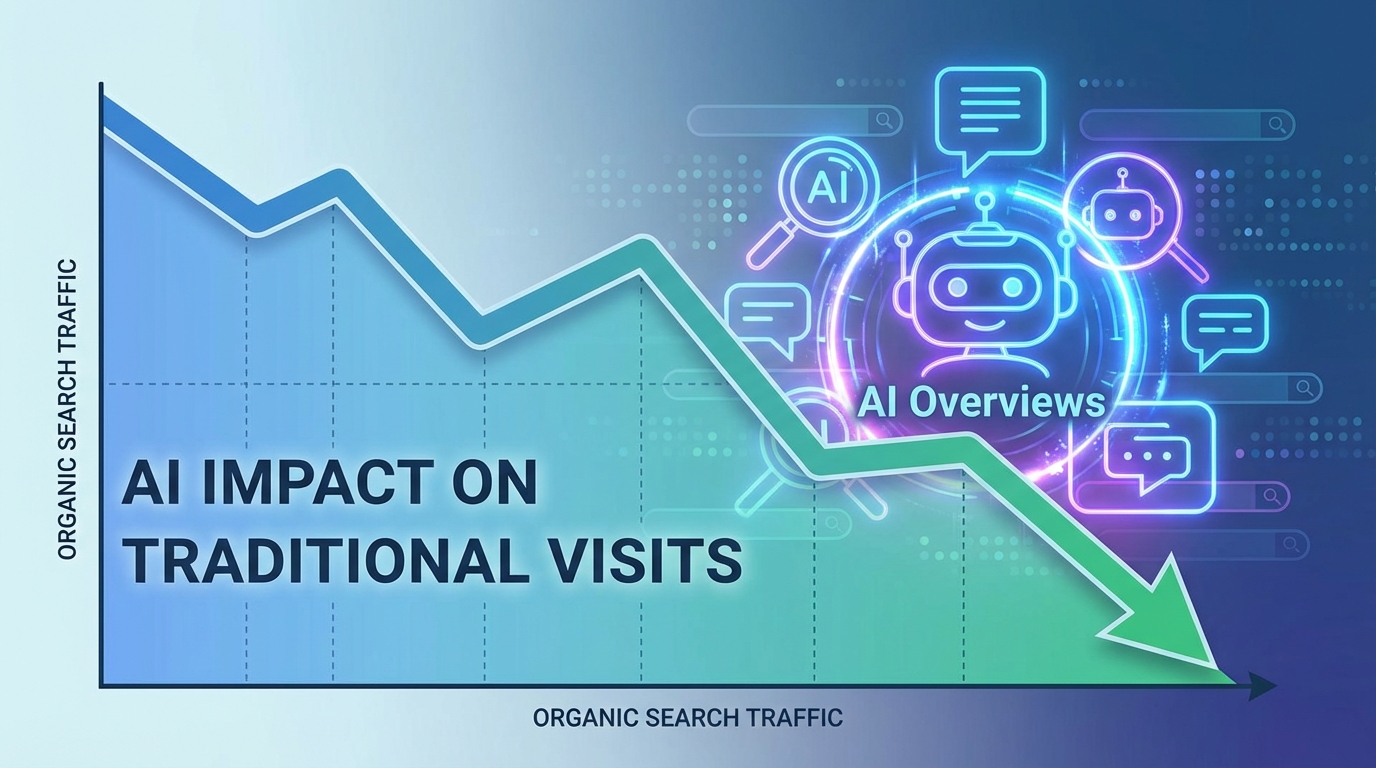
And it's not that people are searching less. They're just finding answers without visiting your site. The journey from question to answer has gotten shorter. Which means the window for capturing attention has gotten smaller too.
But here's where it gets interesting: 44% of users now call AI search their primary source for insights. And 87% of content marketers are already increasing their budgets to account for AI search optimization. The field isn't dying. It's pivoting hard, and fast.
The brands winning in this environment aren't the ones with the most backlinks. They're the ones that AI systems recognize as trustworthy sources.
How Search Actually Works Now
To adapt, you need to understand what's powering these AI responses. Most AI search systems use something called Retrieval-Augmented Generation (RAG), where best link building services can help boost your site’s credibility, making it a trusted source for AI systems to cite. In plain terms, the AI pulls relevant content from across the web in real time and uses it to build a response.
Your content isn't just being ranked anymore. It's being evaluated for inclusion. The AI scans structure, clarity, authority, and relevance. It asks, in its own mechanical way: "Is this source credible enough to cite?"
If you use AI to help draft your initial outlines, it’s a good idea to use an Ai detector to ensure the final version has enough human depth and nuance to meet these high trust standards. Many marketers also rely on a Humanize AI tool to refine robotic phrasing and improve the natural flow of AI assisted content before publishing.
This is where E-E-A-T (Experience, Expertise, Authoritativeness, Trustworthiness) becomes the new keyword density. Google and other AI systems are increasingly using these signals to decide whose content makes the cut. A page stuffed with keywords but written by nobody in particular gets passed over. A page with clear attribution, structured facts, and genuine depth gets pulled into the answer.
Personalization is making this even more complex. Search is no longer a fixed experience. AI systems learn from user history, preferences, and context, which means traditional fixed rankings are becoming less meaningful by the day. Two people searching the same phrase can get completely different AI responses.
SEO Isn't Dead. But It Needs a Serious Upgrade
Let's be clear about something: SEO isn't going away. Core technical practices still matter, including page speed, clean site architecture, proper indexing, and mobile optimization. These aren't optional. They're the floor. Using tools like an seo website checker can help ensure these foundational elements are properly optimized and performing as expected.
But layering GEO strategies on top of that foundation is now what separates the visible from the invisible.
Here's what that looks like in practice:
Structure your content for machines, not just humans. Use schema markup and structured data. AI systems read this like a map. If your content is easy to parse and clearly organized, it's more likely to be used in an AI Overview or AI response.
Write with token efficiency in mind. This is jargon worth knowing. LLMs (large language models) process text in chunks called tokens. Content that's clear, concise, and well-organized gets processed more efficiently. That means cutting filler, using direct language, and front-loading your key points.
Build entity authority. AI systems recognize brands and sources as entities, not just pages. Having your brand mentioned across credible sources, having a Wikipedia presence, and earning citations from authoritative sites all contribute to your entity score. In B2B especially, this determines whether you show up in AI-generated shortlists before a buyer even declares their intent.
Match the way people actually ask questions. AI search is conversational. People type full questions, not just keywords. Your content needs to answer those questions clearly and directly, with the kind of specificity that gives an AI enough to work with.

What Metrics Replace Position 1?
This is the question every marketer is wrestling with right now. If rankings don't tell the full story anymore, what does?
A few emerging metrics worth tracking:
- Share of AI answers: How often does your brand or content appear in AI-generated responses for relevant queries?
- Entity visibility score: How well does the AI "know" your brand as an authority in your space?
- AI citation rate: When AI Overviews appear for your target topics, are you being sourced?
- Brand mention volume: Across forums, publications, and third-party sites, how often is your brand referenced naturally?
These aren't perfectly standardized yet. The measurement frameworks are still maturing alongside the technology. But teams that start tracking these signals now will have a real advantage in 2026 as AI search becomes the default, not the exception.
What's Coming Next
Looking ahead, the AI and SEO impact is only going to deepen. A few trends worth watching:
Agentic commerce is emerging. AI agents are starting to handle decisions and even purchases on behalf of users. If your brand isn't recognized and trusted by these agents, you won't be in the consideration set, period.
Paid ads in AI search are coming at scale. Google is already testing ad integration within AI Overviews, and the line between paid and organic is blurring in conversational search. The playbook for both is converging.
The end of fixed rankings for competitive queries is real. Personalization means no two users see the same results. Winning isn't about dominating a single position. It's about being consistently present across many personalized variations of a search.
By 2028, generative search is projected to influence $750 billion in US revenue. That's not a niche trend. That's the whole game.
Where to Start If You're Behind
Honestly, the gap between "doing traditional SEO" and "ready for GEO" isn't as wide as it sounds. Many brands are already closing this gap by investing in generative engine optimization services that help restructure content for AI visibility while maintaining strong SEO fundamentals. A lot of it comes down to intention and structure.
Start with a content audit. Look at your top-performing pages and ask: Is this content structured clearly? Does it answer questions directly? Is the author or source clearly established? Would an AI trust this enough to cite it?
Then tackle the technical side. Schema markup, fast load times, crawlability, and semantic organization. These aren't glamorous, but they're what get you through the door.
And build your brand's presence off your own site. Guest posts, mentions, interviews, community contributions. Every credible external mention reinforces your entity authority and signals to AI systems that you're a real, recognized player in your space. To accelerate this process, tools like an ai backlink exchange platform can help you build relevant, high-quality backlinks systematically — strengthening both your traditional SEO foundation and your authority signals for AI-powered search.
Final Thought
The shift from SEO to GEO isn't a crisis. It's a recalibration. The fundamentals of good content, clear structure, and genuine authority still matter. They just matter differently now.
AI search doesn't reward tricks. it rewards trust. And building that trust, in the eyes of both humans and machines, is what generative engine optimization is really about.
The brands that figure this out now won't just survive the shift. They'll define what visibility looks like on the other side of it.