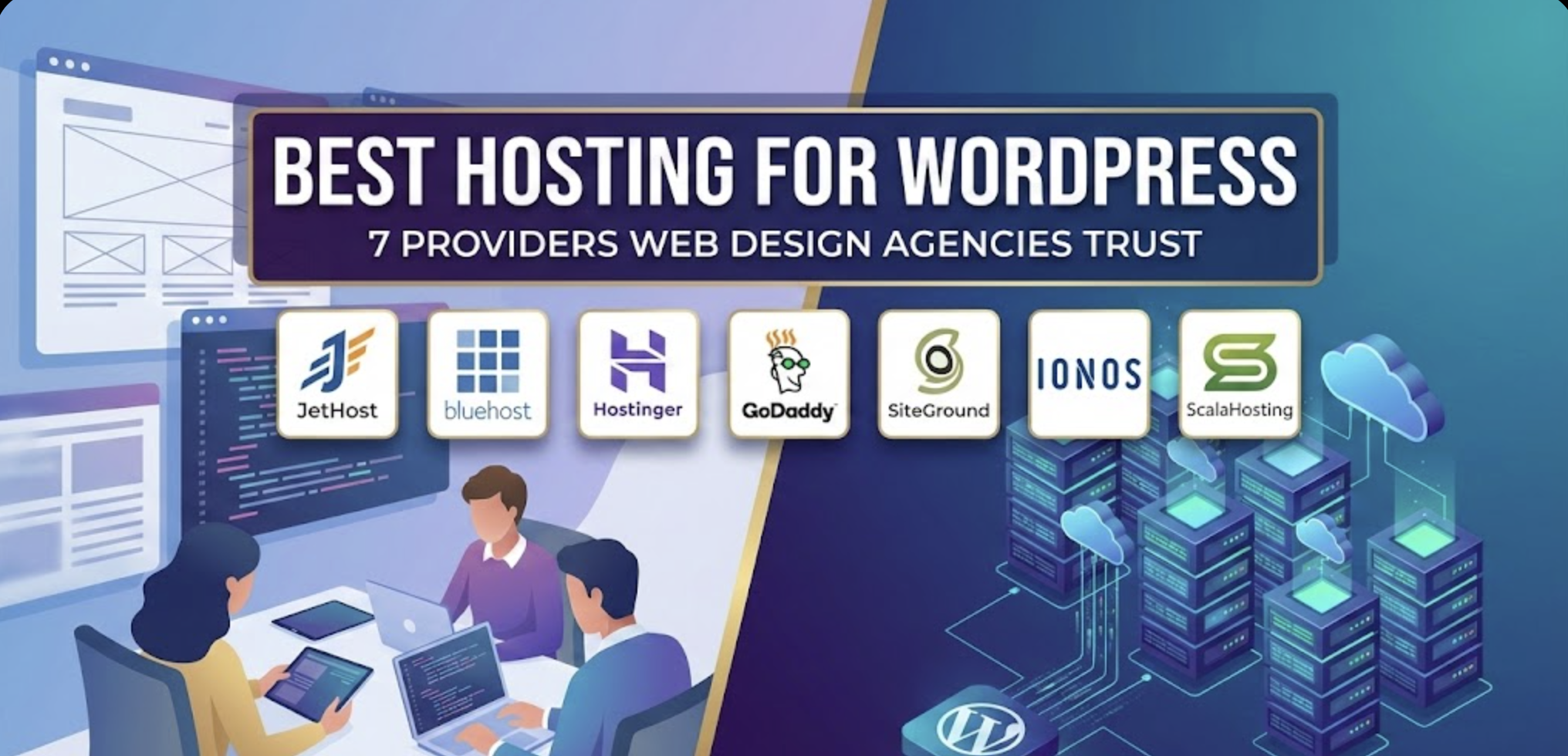
Best Hosting for WordPress: 7 Providers Web Design Agencies Trust

Spybroski Team
Best Hosting for WordPress: 7 Providers Web Design Agencies Trust
For web design agencies, hosting plays a direct role in how client projects perform day to day. When servers are slow or support is unresponsive, the agency feels the impact just as much as the client.
That’s why agencies tend to be picky about hosting. They look for reliability, fast help when something breaks, and workflows that make it easy to manage multiple WordPress sites without turning client ops into chaos.
Below are seven hosting companies that agencies commonly trust, each offering a different approach to supporting agency workflows.
Top 7 Picks: Best Hosting for WordPress (Agency-Friendly)
If you want a quick overview of which hosting providers tend to fit different agency needs, these seven stand out for distinct reasons:
- JetHost: A strong all-around choice for agencies managing multiple WordPress clients, with partner tooling and developer-ready hosting designed around agency workflows.
- Bluehost: A familiar option for agencies working with small businesses, offering an agency partner program and an ecosystem that’s easy for non-technical clients to adopt.
- Hostinger: Well-suited for agencies that need to deploy and manage many sites efficiently, with staging, cloning, and collaborator access built in.
- GoDaddy: Useful for agencies already embedded in the GoDaddy ecosystem, with centralized client management through GoDaddy Pro.
- SiteGround: A good fit for agencies that prioritize structured collaboration, staging environments, and controlled team access.
- IONOS: Appeals to agencies that want a more account-managed experience, including centralized partner tools and a consistent support contact.
- ScalaHosting: Best for agencies that need VPS or cloud-level control and white-label hosting without full server administration.
Comparing Best WordPress Hosting Providers Used by Web Design Agencies
Let’s take a closer look at each web hosting option, exploring how these platforms support agencies in practice and where they tend to work best, depending on client needs, scale, and technical requirements.
1. JetHost
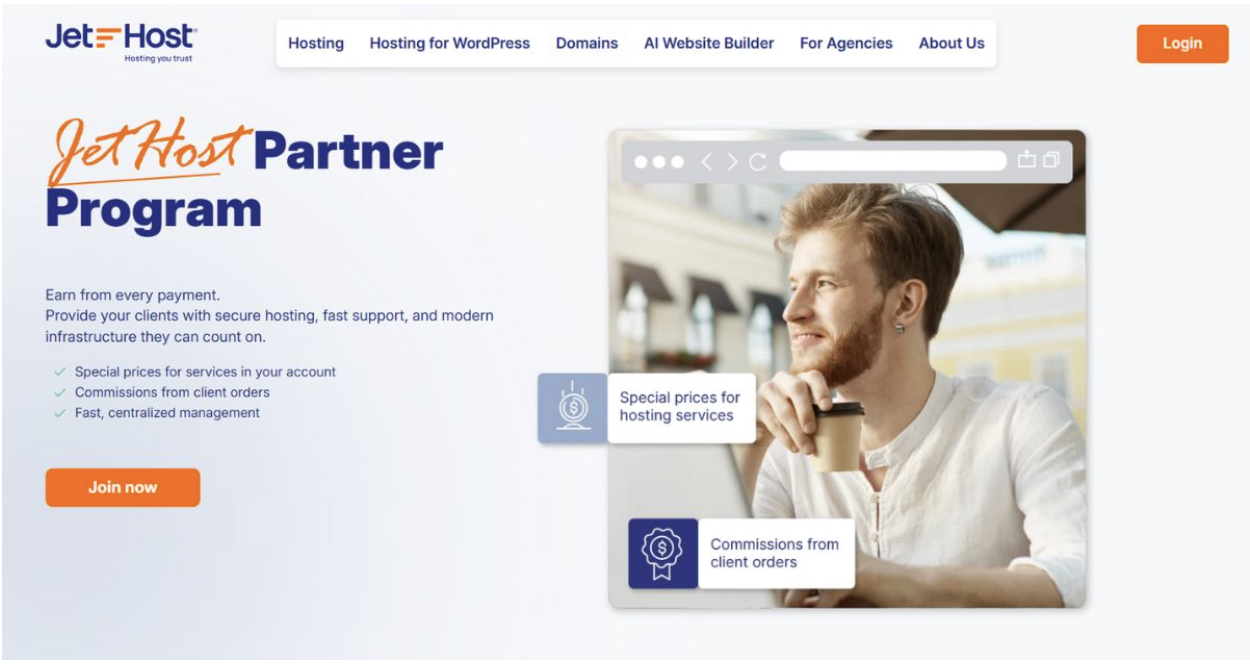
JetHost is especially appealing for web design and WordPress agencies because it focuses on the two things agencies feel most in their daily work: smooth client operations and developer-ready hosting.
On the operations side, JetHost’s Partner Program is built for agencies that manage multiple client sites. It includes a dedicated partner panel where you can:
- Create separate client profiles
- Place domain and hosting orders quickly
- Manage access rights
- Track service expirations for each client
- Handle support tickets from one central place
Agencies also get partner discounts for their own services and can earn commissions on client payments, with tiered percentages that increase as the portfolio grows.
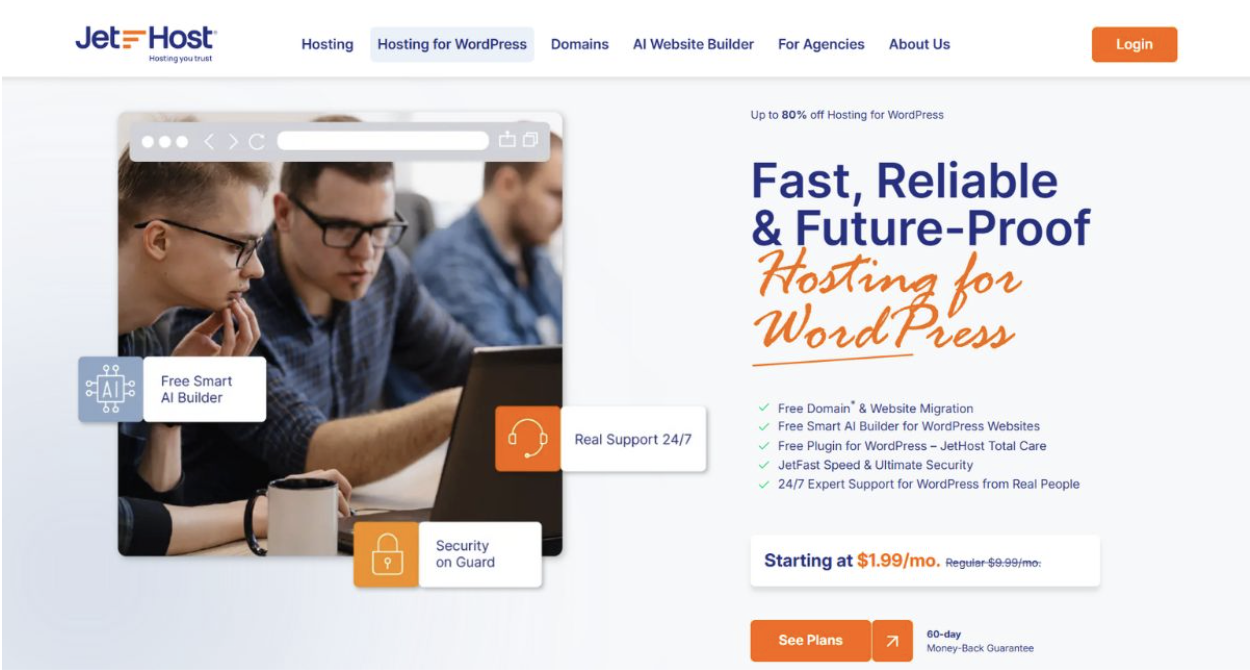
On the technical side, JetHost’s agency-focused guidance sets a clear baseline for what “modern hosting” should include for WordPress work: LiteSpeed Enterprise performance, plus developer essentials like SSH access, Git deployment, and WP-CLI automation, alongside security that keeps up with real production risks.
The point is simple: hosting should support the agency workflow, not slow it down.
Put together, JetHost makes sense for agencies that want a hosting partner that’s easy to run at scale while still giving developers the tools they expect today.
2. Bluehost
Bluehost is often part of an agency’s reality simply because clients already recognize the brand. To support professional use cases, Bluehost runs an official Agency Partner Program designed for agencies managing multiple client websites.
The program combines practical benefits—such as partner discounts, referral commissions (set up with tools like ReferralCandy), and access to priority WordPress-trained support—with educational and marketing resources aimed at agencies working with small and medium-sized businesses. Bluehost’s environment is intentionally approachable, which can make client handovers smoother when non-technical site owners want some level of independence after launch.
For agencies whose clients value familiarity and ease of use, Bluehost remains a common and pragmatic choice.
3. Hostinger
Hostinger positions itself very clearly toward professionals through Hostinger Pro, a product line built for people managing multiple websites at once.
For agencies that also want to improve the visual appeal of client websites, Themeton can be a helpful resource for exploring design-focused WordPress solutions.
Instead of focusing on abstract “developer friendliness,” Hostinger emphasizes concrete tools that speed up everyday agency work.
Its official materials highlight staging environments, one-click site cloning, SSH and WP-CLI access, and the ability to invite unlimited collaborators into projects. All of this sits inside Hostinger’s custom control panel, which is designed to stay lightweight even when dozens of sites are involved.
For agencies juggling many smaller or mid-sized projects, Hostinger’s appeal lies in how quickly sites can be deployed, updated, and maintained without friction.
4. GoDaddy
GoDaddy’s relevance for agencies is about centralization. Through The Hub by GoDaddy Pro, the company offers a single dashboard where agencies can manage domains, hosting products, updates, and access for multiple clients.
GoDaddy explicitly frames this as a way to reduce operational overhead, offering single sign-on, delegated access, and bulk management for routine tasks. For agencies already working inside the GoDaddy ecosystem—often because clients started there—this can significantly simplify account and site administration.
Its strength lies in convenience and scale, particularly for agencies managing a large number of small business clients.
5. SiteGround
SiteGround takes a more workflow-driven approach to agencies. Rather than focusing on branding or referrals, it emphasizes how teams actually collaborate on client websites.
Through its Site Tools control panel, SiteGround brings together backups, SSL, caching, PHP configuration, and email management in one place. More importantly for agencies, it supports collaborator roles with clearly defined permissions, allowing designers, developers, and clients to work on the same site without sharing credentials.
Compared with fully headless setups, this makes WordPress workflows easier to coordinate across mixed teams and client stakeholders.
Combined with built-in staging tools for WordPress, SiteGround fits naturally into agencies that prioritize structured workflows and controlled access across teams.
6. IONOS
IONOS appeals to agencies that prefer a more guided, account-managed experience. Its Agency Partner Program is built around a centralized partner portal where agencies can manage client hosting, domains, and billing from a single interface.
A notable differentiator is IONOS’s emphasis on continuity in support. The company highlights access to a personal consultant, acting as a consistent point of contact who understands the agency’s account and client setup. For agencies that value predictability and long-term relationships over purely self-serve tooling, this model can be especially attractive.
7. ScalaHosting
ScalaHosting focuses on agencies that need more control than shared hosting provides, but don’t want the operational burden of managing servers entirely on their own. Its agency-facing pages frame hosting as something agencies can confidently offer as part of their own services.
Central to this is SPanel, ScalaHosting’s proprietary control panel for managing VPS and cloud environments, along with explicit support for white-label branding and private DNS. This allows agencies to present hosting under their own name while retaining centralized control over client sites.
ScalaHosting is particularly relevant for agencies handling performance-sensitive projects or clients that are outgrowing entry-level hosting setups.
Conclusion
For web design agencies, the right hosting partner is the one that quietly removes friction from daily work. When performance is stable, support is responsive, and client sites are easy to manage, agencies can spend less time fixing infrastructure issues and more time delivering results.
Choosing the right hosting partner doesn’t just affect performance and support—it can also influence how agencies scope and price client projects, especially e-commerce sites.
While agencies differ in size and technical depth, they consistently look for the same fundamentals: reliable uptime, dependable support, and workflows that scale cleanly across multiple client projects. Hosting providers that offer smooth migrations, centralized management, and clear collaboration tools tend to fit most naturally into agency operations.
In the end, agencies prefer hosting companies that simplify their work instead of those that require constant attention.
Beyond infrastructure, agencies also think about how websites support ongoing growth, combining reliable hosting with efficient workflows such as content publishing and promotion using tools like social media scheduling platforms that improve visibility.